

Buy Custom Decals for Sports Teams: 2026 How-to Guide
Table of Contents
- What You'll Need Before You Buy Custom Decals
- Step 1: Choose the Right Decal Type for Your Team
- Step 2: Prepare Artwork and Confirm Logo Permissions
- Step 3: Size, Shape, and Quantity Planning
- Custom Team Logo Decals: Design and Color Choices
- Sports Helmet Decals: Sizing and Surface Prep
- Outdoor Vinyl Decals: Weather Resistance and Care
- Custom Decals for Sports Equipment: Lockers, Bats, and Bumpers
- Frequently Asked Questions
Last Updated: October 17, 2026
What You'll Need Before You Buy Custom Decals
Buying custom decals for sports teams starts long before you open a design tool.
Most bottlenecks are avoidable with a short checklist.
Here is what to have ready before you order:
- Vector logo file (AI, EPS, PDF) or a high-resolution PNG at least 300 DPI
- Written confirmation that the team, league, or school approves the logo use
- Final roster, so name and number sets match the current season
The single most common mistake we see is a coach sending a screenshot of the team logo pulled from a phone. It looks fine on screen and prints badly at 30 centimetres wide. Ask whoever designed the logo for the original file. If nobody has it, a printer can usually rebuild a clean vector version.

Step 1: Choose the Right Decal Type for Your Team
The right decal type depends entirely on the surface it sticks to and how long it needs to last. A helmet decal and a wall graphic are not the same product, even when they carry the same logo. Choosing by surface first, then by material, saves money and prevents the peeling and bubbling that gives cheap decals their reputation.
Helmet, equipment, window, and wall decal use cases
| Decal Type | Best For | Typical Material | Removable? |
|---|---|---|---|
| Helmet decals | Football, hockey, lacrosse helmets | Cast vinyl with laminate | Yes, with heat |
| Equipment decals | Bats, sticks, pads, water bottles | Calendared vinyl | Yes |
| Window stickers | Clubhouse doors, storefronts, vehicles | Static cling or low-tack vinyl | Usually |
| Wall graphics | Locker rooms, gym walls, hallways | Removable adhesive vinyl or fabric | Yes |
| Bumper stickers | Team parents, booster club vehicles | Outdoor vinyl | Semi-permanent |
| Magnets | Car doors, temporary signage | Magnetic sheet | Yes, reusable |
Helmet decals need the thinnest, most conformable vinyl because helmet shells are curved in two directions at once. Window and wall decals can use thicker material because the surface is flat.
If you are ordering for a whole program, do not assume one material covers everything. A single order can mix helmet, window, and wall decals, and it usually should.
Step 2: Prepare Artwork and Confirm Logo Permissions
Logo permission is the step teams skip, and it is the one that stops production cold. School districts, minor leagues, and national governing bodies often own the marks you want to print, and a printer cannot legally reproduce them without the rights holder's approval.
Artwork preparation comes down to file format, resolution, and colour. A vector file scales to any size without losing sharpness. A raster file (JPG, PNG) has a fixed number of pixels, so it blurs when enlarged. Send the vector version whenever it exists.
File formats that print cleanly
- Vector (preferred): AI, EPS, PDF, or SVG. These are resolution-independent and can be scaled to any decal size without losing edge sharpness.
- High-resolution raster (acceptable): PNG or JPG at 300 DPI at the final print size. A 30-centimetre-wide decal needs roughly 3,540 pixels across at 300 DPI; a phone screenshot is usually far below that.
- Unacceptable without rebuild: Screenshots, social media images, Word documents, and photos of a jersey. These force a redraw, which adds a day or two and a redesign fee.
If nobody has the original vector file, a printer can usually rebuild a clean version from a high-resolution image. Ask for a proof of the rebuilt file before approving the run.
Colour matching: Pantone, CMYK, and thread colours
Ask for Pantone or CMYK values rather than describing the shade. "Team blue" means nothing to a press operator; a Pantone number means everything. If you only have a photo of the jersey, expect an approximate result. For school and league marks, the rights holder often publishes an official colour guide, request it alongside the logo file.
Logo permissions: what to get in writing
Permission requirements vary by rights holder. A common pattern is:
- School or district marks: approval from the athletics director or communications office, often on a district letterhead or official email.
- League or association marks: written consent from the league office, sometimes with a royalty or licensed-vendor requirement.
- Professional or major-college marks: usually restricted to licensed vendors; a local printer may not be permitted to reproduce them at all.
- Original team marks: if the team commissioned the logo, confirm the designer transferred reproduction rights in writing.
Proofing before production
Ask for a digital proof showing the decal at final size, in final colour, on the intended material. Check three things: spelling of names and numbers, colour accuracy against the official guide, and cut-line placement around the logo. Approve the proof in writing.
Step 3: Size, Shape, and Quantity Planning
Measure the surface, not the decal. Width is always the left-to-right measurement, and height is top to bottom.
Shapes fall into two families: custom cut and standard cut. Custom cut vinyl follows the outline of your logo exactly, which looks sharp but takes more production time.
Quantity planning follows a simple formula:
- Count players per team and multiply by the number of decals each needs.
- Add spares: one extra per player for helmets, two per team for equipment.
- Add a set for coaches, trainers, and boosters.
- Round up to the nearest sheet size your printer offers.
Ordering in bulk lowers the per-unit cost noticeably, but only if the artwork stays the same across the run.
Custom Team Logo Decals: Design and Color Choices
Custom team logo decals work best when the design respects the size it will print at. Fine detail, thin lines, and small text disappear below about 5 centimetres wide.
Player Name and Number Decals →
Colour choice matters more outdoors than indoors. Vibrant colours hold up well in vinyl, and a glitter or metallic finish adds visibility on helmets and equipment without changing the logo's shape.
We recommend a simple rule: one version of the logo for anything under 10 centimetres, one for anything larger.
Sports Helmet Decals: Sizing and Surface Prep
Sports helmet decals need a clean, warm, dry surface and a slow, squeegee-led application.
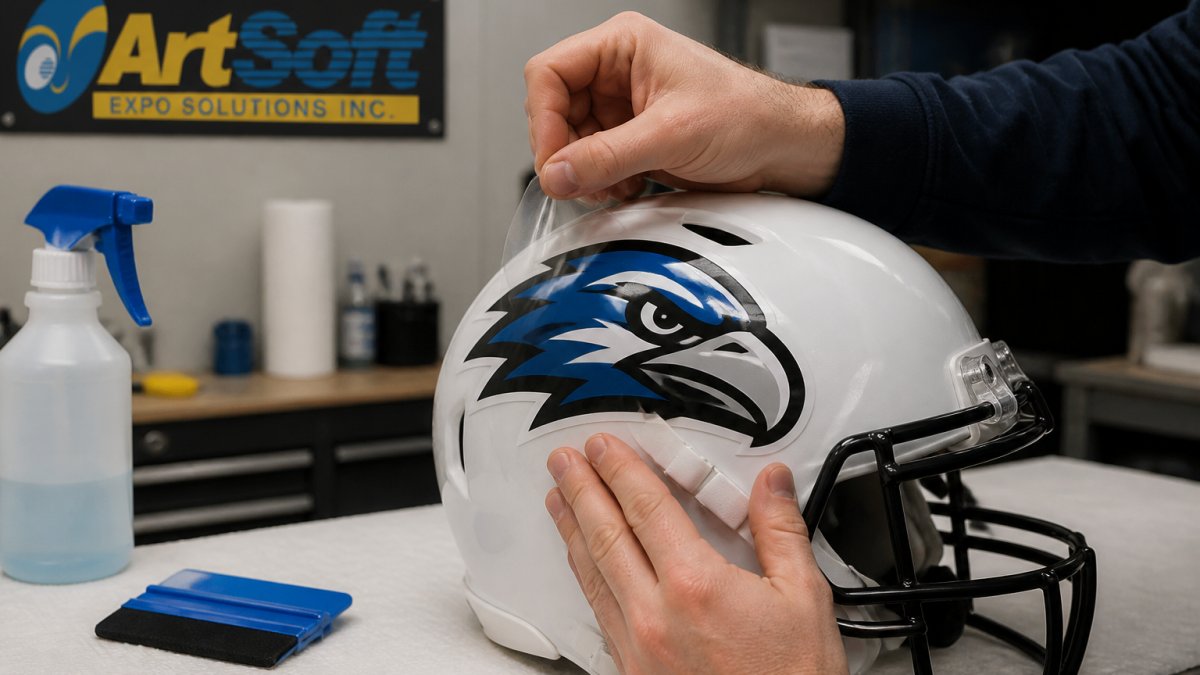
Prep the helmet in four steps:
- Wipe the shell with isopropyl alcohol and let it dry fully.
- Test-fit the decal with tape before removing the backing.
- Apply with a squeegee from the centre outward to push out air.
- Warm the edges gently with a heat gun or hair dryer to set the adhesive.
Sizing follows the helmet, not the player. Measure the flat area between the ear hole and the crown, then size the decal to fit inside that space with a small margin.
Outdoor Vinyl Decals: Weather Resistance and Care
Outdoor vinyl decals survive weather when the material, the laminate, and the application are all correct. Cast vinyl with a UV laminate handles sun, rain, and freeze-thaw cycles far better than uncoated calendared vinyl. The laminate is what protects the ink from fading, so do not skip it on anything that lives outside.
Expected lifespan by surface and exposure
Lifespan depends on the surface, the material, and how much sun the decal sees. A common pattern for cast vinyl with UV laminate is:
- Vehicle windows and bumpers: several years outdoors when applied to a clean, room-temperature surface and washed by hand.
- Helmets and equipment: one to several seasons, depending on handling and storage; helmets stored in hot vehicles or equipment bags fade and lift faster.
- Locker-room and gym walls: many years indoors, but removable adhesives may leave residue on painted drywall after long dwell times.
Calendared vinyl without laminate is a shorter-life option best reserved for indoor or short-season use.
Care by surface
- Vehicles: hand-wash with mild soap and water, rinse, and dry with a soft cloth. Avoid pressure washers directly on the decal edge, and skip abrasive pads entirely. Do not wax over the decal edge.
- Helmets and equipment: wipe with a damp cloth after use; avoid solvent cleaners that can attack the adhesive. Store helmets out of direct sun and away from hot vehicles.
- Windows: use a standard glass cleaner on the glass around the decal, not directly on the edge, and avoid razor blades near the film.
Removal without damage
Removal is where outdoor decals cause the most surprise. A common approach is to warm the decal gently with a hair dryer to soften the adhesive, peel slowly at a low angle, and remove residual adhesive with an adhesive remover approved for the surface. On painted walls, test any remover in an inconspicuous spot first, some solvents lift paint along with the adhesive.
Temperature and application timing
Apply to a surface that is at least room temperature. Cold vinyl cracks when it flexes, and a decal applied in a cold garage in January will not bond properly. Avoid applying in direct sun on a hot day, because the vinyl becomes too soft to squeegee air out cleanly. A common window for outdoor application is a mild, dry day with the surface in shade.
Custom Decals for Sports Equipment: Lockers, Bats, and Bumpers
Custom decals for sports equipment cover the surfaces nobody thinks about until they need labelling: lockers, bats, helmets, bumpers, and team vehicles.
For player name and number sets, our Player Name and Number Decals come as a complete set at $60.00, including 12 sets with one team logo, one player number, and one player name each.
Locker decals should be removable so they can move with the player. Bat and equipment decals need a laminate to survive the dugout. Bumper and vehicle decals need outdoor-rated vinyl.
Frequently Asked Questions
What material is best for outdoor sports team decals?
Cast vinyl with a UV-resistant laminate holds up best outdoors. It conforms to curved surfaces like helmets and bumpers, resists fading from sun exposure, and stays waterproof through rain and wash cycles. Cheaper calendered vinyl works for short-season indoor use but can shrink and peel within a year outside. If your decals go on field signs, trailers, or exterior windows, ask for cast vinyl with laminate and confirm the adhesive is rated for the surface you're applying to.
Can custom team decals be made for helmets and equipment?
Yes. Helmet decals are typically cut to fit the shell's curve and applied with a transfer tape so the logo sits flat without wrinkles. Player name and number sets are common for baseball and football programs. For equipment like bats, lockers, and bumpers, choose a thinner vinyl that conforms to tight curves. Clean the surface with isopropyl alcohol and let it dry fully before applying, then press from the center outward with a squeegee to push out air bubbles.
What file format should I use for a team logo decal?
Send vector files (AI, EPS, or PDF) whenever possible. Vector artwork scales to any decal size without losing sharp edges, which matters when a logo goes from a 5 cm locker sticker to a 60 cm wall graphic. If you only have a PNG or JPG, use the highest resolution available, ideally 300 dpi at final print size. Confirm you have permission to reproduce any third-party logo, such as a school crest or league mark, before the order goes to production.
How do I order custom decals in small quantities for a team?
For a single team, a player name and number set is a practical starting point: one order can cover a full roster with a team logo, player number, and player name per set, and extra sets can be added individually. Gather your roster list, logo file, and color codes first, then request a proof so you can check spelling and numbering before production begins.
Ordering custom decals for sports teams gets a lot easier when the artwork, permissions, and measurements are settled before the order goes in. Artsoft Expo Solutions Inc. handles custom team decals, sponsorship banners, and modular display systems with fast shipping and high-resolution printing, so a program can brand helmets, lockers, windows, and event displays through one vendor. Get started with Artsoft Expo Solutions Inc. and put a clean, durable team mark on every surface that matters.