

4 Steps to Choosing a Backlit Popup Display
Last Updated: November 7, 2026
Quick Summary
Choosing a backlit popup display means matching the finish, size, and power plan to your booth. Pick SEG construction for even LED backlighting, size the display to your backwall with 0.3 to 0.6 meters of margin, and confirm one outlet per LED transformer before you order.
- SEG graphics sit frameless and flat, so LED lighting reads evenly without sagging shadows.
- A 3-meter booth suits a 2.3-meter or 3-meter backlit display; island spaces handle 4.6-meter and 6.1-meter configurations.
- Leave 0.3 to 0.6 meters of margin on each side rather than filling the entire backwall.
- One person can set up most sizes in 30 to 40 minutes with no tools.
- Each LED transformer needs its own outlet, so a two-frame 6.1-meter build needs two power drops.
Table of Contents
- What a Backlit Popup Display Does for Booth Visibility
- Fabric Pop Up Display vs SEG Backlit Display: Which Finish Suits Your Booth
- Backlit Display Size Guide: Matching Width to Booth and Budget
- Portable Backlit Display Setup, Power and Replacement Graphics
- Frequently Asked Questions
What a Backlit Popup Display Does for Booth Visibility
A backlit popup display is a portable trade show exhibit that pushes LED light through a printed fabric graphic, so your booth glows instead of fading into the aisle.
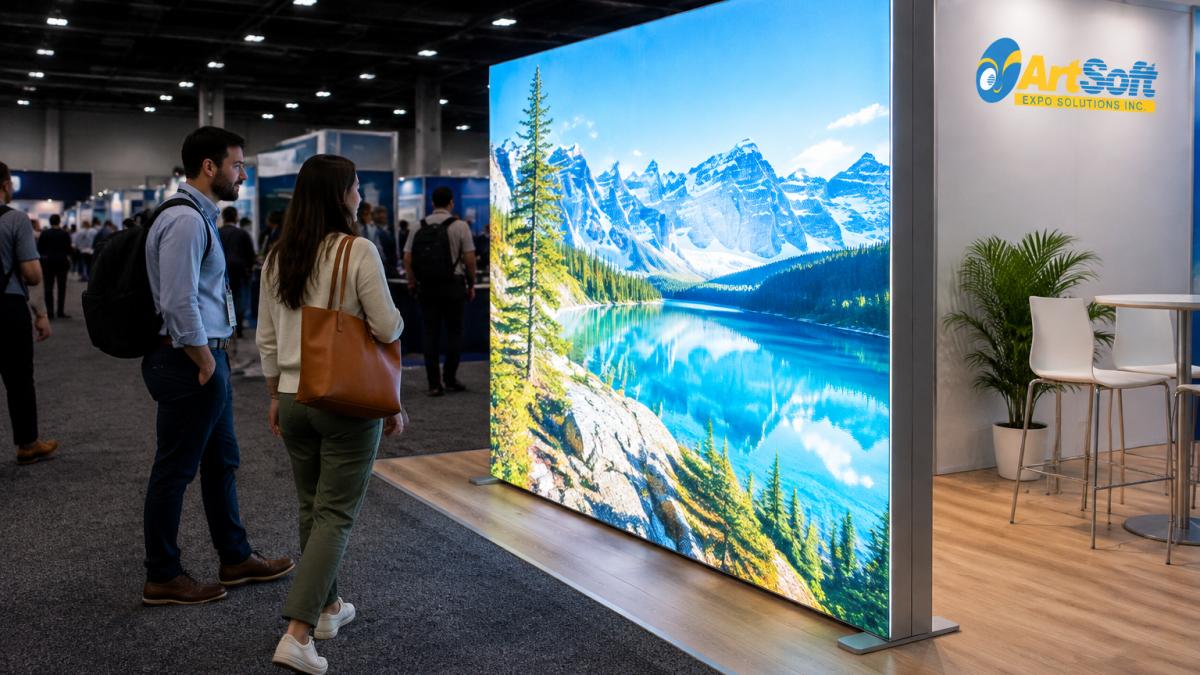
The difference is contrast. Most booths use flat, non-lit panels; a light box illuminates the whole fabric graphic evenly, so colors stay consistent and text reads from a distance, turning a passing attendee into a stopped one.
Fabric Pop Up Display vs SEG Backlit Display: Which Finish Suits Your Booth
The choice between a fabric pop up display and a SEG backlit display comes down to finish, setup speed, and how often you change artwork. A standard fabric popup stretches a printed graphic over a collapsible frame with channel bars. A SEG display uses silicone edge graphic construction: a silicone bead sewn into the graphic's edge presses into a groove on the frame, producing a clean, virtually frameless look.
For backlit systems, SEG wins on appearance. The graphic sits taut and flat, so LED lighting reads evenly with no sagging shadows. Fabric popups still make sense when budget is tight and lighting is not a priority. If you want the lit look, view our 3-meter backlit SEG popup to see the finish in practice.

| Feature | Fabric Pop Up | SEG Backlit |
|---|---|---|
| Finish | Stretched over frame | Frameless, edge-inserted |
| Lighting | Non-lit or add-on | Built-in LED illumination |
| Graphic swap | Hook-and-loop or channel bar | Silicone edge re-insert |
| Best for | Tight budgets | High-impact booths |
How to decide in three questions
Most buyers can settle the fabric-versus-SEG question with three checks:
- Will the display be lit? If yes, SEG is the practical default. A non-lit fabric popup can take an add-on light kit, but the light sits in front of the graphic, causing hotspots and glare instead of even backlighting. Unlit, a standard fabric popup is lighter and cheaper.
- How often will the graphic change? SEG graphics re-insert in minutes and store flat, suiting brands that refresh artwork between shows. Hook-and-loop and channel-bar graphics are swappable too, but stretch and alignment take more fussing.
- What does the booth need to look like up close? SEG's frameless edge reads as a finished wall, which matters for island booths and camera-facing backwalls. A fabric popup shows its frame and channel bars at the edges, fine for a perimeter booth viewed from a distance.
Where each finish actually wins
SEG backlit systems earn their premium for booths that need to be seen from across a hall, brands with strict color standards, and exhibitors who swap graphics two or more times a year. Standard fabric popups win when the display is secondary, the booth is small and viewed close-up, or the budget is fixed and lighting is not part of the plan.
Watch out: a SEG graphic printed for front-lit viewing will look washed out when backlit, so confirm the artwork is prepared for backlighting before you commit to the SEG route.
Backlit Display Size Guide: Matching Width to Booth and Budget
Match display width to your booth footprint first, then to budget. A 3-meter booth suits a 2.3-meter or 3-meter backlit display. Larger island spaces handle 4.6-meter and 6.1-meter configurations, often built by connecting two frames.
Our backlit popup display range runs from a compact 2.3-meter backlit SEG popup up to a 6.1-meter backlit SEG popup for full-wall brand visibility. Straight and curved configurations are both available. One person can set up most sizes in 30 to 40 minutes.


A practical sizing framework
Work through the booth in this order:
- Measure the usable backwall, not the booth. Deduct aisle clearance and any side walls or storage; a 3-meter booth typically leaves about 2.7 to 3 meters of backwall once you allow for a counter or side table.
- Leave breathing room. A display that fills the entire backwall reads as a wall, not a focal point. Most practitioners leave 0.3 to 0.6 meters of margin on each side.
- Pick straight or curved by traffic flow. Straight configurations maximize graphic area and suit perimeter booths viewed head-on; curved configurations wrap the viewing angle and work better on island booths.
- Confirm the height clears the venue. Backlit popups commonly run 2.3 to 2.4 meters tall; check ceiling and rigging rules, since some halls restrict tall structures near fire exits.
- Size the power plan to the display. Each LED transformer needs its own outlet, so a 6.1-meter configuration built from two frames needs two power drops. Confirm outlet locations on the venue floor plan before you order.
Budget and total cost of ownership
Upfront price is only part of the picture. A backlit popup's cost over several events includes the frame and LED system, replacement graphics, shipping and storage, and spare LED components. A larger display costs more to ship and needs more storage, so a 6.1-meter wall used twice a year can cost more per show than a 3-meter system used monthly.
A useful rule: buy the largest display your booth footprint and storage can support, but size the graphic swap plan to your event calendar. If you exhibit four or more times a year, budget for at least one replacement graphic set in the first year.
Watch out: ordering a display that exactly matches the booth width leaves no room for a counter or side table, and exhibitors often discover the squeeze only at setup.
Portable Backlit Display Setup, Power and Replacement Graphics
Setup is tool-free: unfold the frame, lock the channel bars, press the SEG graphic into the frame edge, then connect the LED ladder light set. Each transformer needs its own power cord, so plan venue power access before you arrive and check your electrical draw against the venue's exhibitor guidelines.
Watch out: forgetting to confirm power drop locations is the most common setup delay we hear about.
Replacement fabric graphics for backlit displays swap in without new hardware, so you can refresh artwork between shows. Keep a spare LED light for your popup display and a graphic-only SEG backlit popup on hand, and a damaged panel never costs you a show. Pack everything in the included carrying case.
Choosing a backlit popup display is easier when you match finish, width, and power to how you actually exhibit. Artsoft Expo Solutions Inc. manufactures SEG backlit fabric displays with lightweight, easy-to-set-up hardware, fast shipping, and a wide variety of print and material options. Get started with Artsoft Expo Solutions Inc. and put a booth on the floor that people notice.
Frequently Asked Questions
How do you choose the right size backlit display?
Start with your booth footprint and the viewing distance. A 2.3-meter backlit popup display suits a 3x3 meter booth where visitors stand close, while a 3-meter unit fills a 3x6 meter space and reads from further down the aisle. Measure the wall you want to cover, leave clearance for counters and storage, and check the venue's booth regulations before ordering. If you exhibit at several show sizes, a modular frame that connects to a second unit lets one purchase cover both layouts.
How easy are backlit popup displays to set up and transport?
Artsoft's SEG backlit popups are built for one-person portable backlit display setup, taking roughly 30 to 40 minutes from case to finished wall. The frame unfolds, channel bars lock in, and the backlit fabric presses into the silicone edge groove. Everything packs into two travel bags: the 2.3-meter system weighs about 41 kg total, and the 3-meter about 44 kg. Confirm your vehicle or courier can handle the case dimensions of 0.91 x 0.36 x 0.33 meters before the show.
Can you replace the fabric graphic on a backlit display?
Yes. Replacement fabric graphics for backlit displays are ordered as separate printed pieces, so you keep the frame, lights and transformers and swap only the fabric when a campaign changes. Artsoft lists rush options per fabric, from 5 business days at $250 up to next business day at $550 on the 2.3-meter and 3-meter units. Keep your print files and confirm the artwork is prepared for backlit output, since unlit colors print darker than they appear on screen.
