

Durable Modular Signage for Retail Stores
Table of Contents
- What Is Durable Modular Signage for Retail Stores
- Quick Comparison of Modular Signage Systems
- How to Update Retail Window Displays Frequently
- Durable Materials for Indoor Retail Signs
- Cost-Effective Retail Signage Solutions
- Installation, Reconfiguration, and Maintenance
- Which System Should You Choose
- Frequently Asked Questions
Last Updated: October 11, 2026
What Is Durable Modular Signage for Retail Stores
Durable modular signage for retail stores refers to lightweight, interchangeable display systems built from aluminum extrusions and powder-coated metal bases that let you swap out graphics and components without replacing the entire structure. These systems are designed to withstand frequent reconfiguration, making them ideal for retailers who update window displays seasonally or run rotating promotional campaigns. The real advantage is flexibility: you invest once in the frame hardware, then swap printed panels, wing kits, and accessories as your messaging changes.
Artsoft Expo Solutions Inc. designs modular systems with aluminum extrusion frames engineered for repeated assembly and disassembly, paired with full-color printed fabric graphics and customizable wing kits.
Quick Comparison of Modular Signage Systems
| System | Size | Starting Price | Best For | Lead Time |
|---|---|---|---|---|
| 1010S01 | 9.5 ft W × 7.5 ft H | $2,199 | Budget-conscious retailers | 5-8 days |
| 1010S01B | 9.5 ft W × 7.5 ft H | $3,099 | Teams needing counter panels | 5-8 days |
| 1010S05 | 9.5 ft W × 9.5 ft H | $2,999 | Larger window displays | 5-8 days |
| 1020S01 | 18.5 ft W × 7.5 ft H | $3,950 | Multi-section storefront signage | 10-12 days |
Systems range from 9.5-foot to 18.5-foot widths. Smaller systems ship in 5-8 days; larger ones in 10-12 days. All include aluminum frames, powder-coated bases, full-color fabric graphics, and expandable wing kits.

How to Update Retail Window Displays Frequently
Frequent display updates keep customer attention high and signal an active store. A modular system lets you refresh your entire window in under an hour without tools or technical expertise.
Your design team creates artwork and sends it to the printer. When graphics arrive, unclip old panels from the frame and clip in new ones. No hardware dismantling, disposal costs, or rebuild downtime.
Modular systems remove the friction of traditional signage: weeks of lead time, installation costs, and disposal. With Artsoft Expo Solutions Inc., you're changing graphics, not rebuilding infrastructure.
Wing kits add curved or extended panels for $240 per set, letting you swap configurations across campaigns while your core frame stays stable.
Durable Materials for Indoor Retail Signs
Indoor retail signage must hold color under fluorescent and LED lighting, resist dust, withstand cleaning, and maintain readability without fading.
Stretch Fabric Graphics: Longevity and Light Diffusion
Stretch fabric graphics on polyester diffuse light evenly, reducing glare.
Replacement fabric panels cost $675-$800 depending on size.
Wipe fabric with a soft, damp microfiber cloth; avoid abrasive cleaners.
Sintra Panels: Rigidity and Dimensional Durability
Sintra (expanded PVC foam-core) accepts vinyl decals or direct printing, ideal for geometric designs.
Sintra resists impact better than fabric but fades under direct sunlight. It's ideal for indoor environments.
Sintra costs $240-$320 per pair to replace.
High-Quality Vinyl: Maximum Durability Against Contact and Handling
High-quality vinyl resists scuffs, contact, and fading. It tolerates cleaning chemicals and abrasive wiping, ideal for high-traffic environments.
Vinyl tolerates standard retail cleaning products without degradation.
Comparative Durability Under Retail Conditions
Choose your material based on your retail environment and update frequency:
- Fabric: Best for retailers changing displays every 4-8 weeks in climate-controlled indoor spaces. Lowest maintenance, fastest updates, ideal for high-volume campaign rotation.
- Sintra: Best for quarterly rotations or permanent interior installations with geometric designs. More durable against impact; less durable against UV if near windows.
- Vinyl: Best for high-traffic areas, frequent cleaning, or maximum durability between updates. Ideal for photo-heavy designs and environments where displays get touched or bumped regularly.
Aluminum frames and powder-coated bases resist corrosion.
Cost-Effective Retail Signage Solutions
The true cost of signage isn't the upfront purchase, it's the total cost of ownership. Most retailers underestimate replacement and installation costs. A modular system flips that math.
Modular approach: Invest $2,199-$3,950 once, replace graphics ($240-$800) as needed.
Artsoft Expo Solutions Inc. offers rush services: 3-day turnaround for $500, next-day for $800. Standard lead time is 5-8 days.
Main panels cost $595-$820, wing kits $240-$480 per pair, and optional components $75-$355. You control when and how much you spend.
Installation, Reconfiguration, and Maintenance
Modular systems are designed for non-technical users, but proper installation and maintenance also require attention to accessibility standards and legibility compliance.
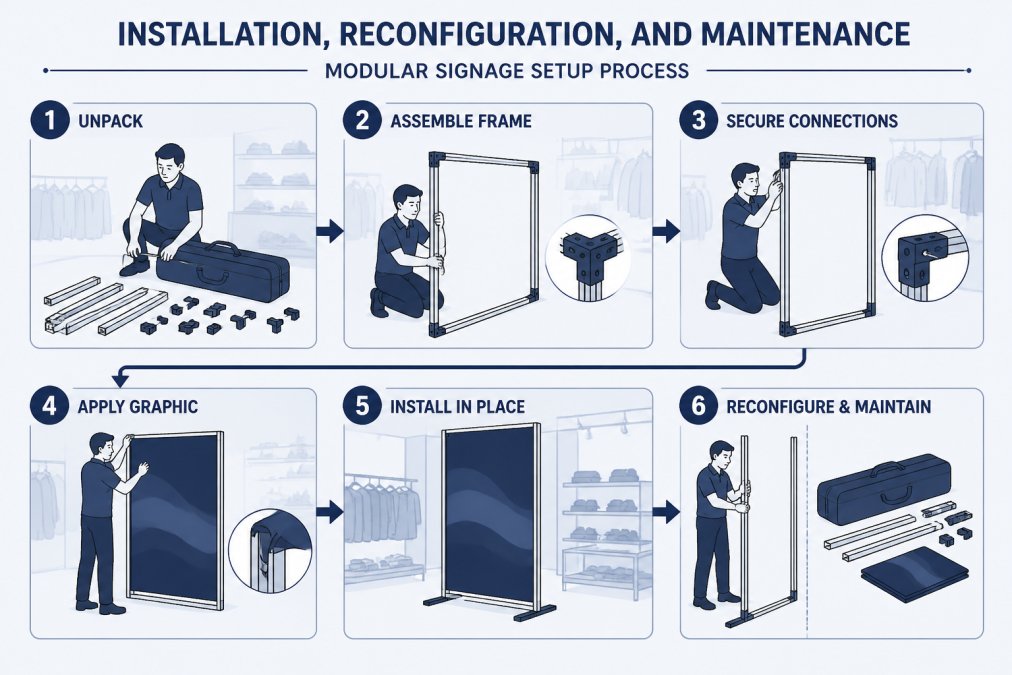
Assembly and Setup
Assembly takes 30-45 minutes. The aluminum frame slots together intuitively, and the powder-coated base provides stability without anchors. Fabric graphics clip in using a simple tension system. Setup instructions and digital templates guide assembly.
Reconfiguration takes 15-20 minutes: unclip old panels, clip in new ones, adjust wing kits. No tools or specialized labor required.
Accessibility Compliance and Legibility Standards
Retail signage must comply with accessibility standards. Modular systems' content and placement must meet these standards:
- Text contrast: Minimum 3:1 ratio. Dark text on light backgrounds (or vice versa) is essential.
- Text size: At least 16 points for body copy, 24 points for headings.
- Wayfinding: Place at 1.4-1.6 metres height with consistent symbols. Modular systems' adjustable layouts make compliance easier.
- Tactile elements: Sintra panels accommodate raised lettering or Braille; fabric cannot.
Placement and Visibility
Modular systems' flexibility allows you to position signage for optimal visibility and accessibility. Best practices:
- Mount primary signage at eye level (1.4-1.6 metres) for standing customers.
- Avoid placing signage where it creates a tripping hazard or obstructs sightlines.
- For window displays, position text and key graphics in the upper two-thirds of the window where they're visible from the street and from inside the store.
Modular systems' lightweight frames and adjustable mounting options make repositioning for accessibility straightforward. Unlike permanent signage, you can test placement, gather feedback, and adjust without cost or downtime.
Maintenance and Longevity
Maintenance is minimal but deliberate. Aluminum extrusions resist corrosion and don't require refinishing. The powder-coated base plates are scratch-resistant and can be wiped clean with a soft cloth. Fabric graphics stay vibrant under indoor lighting and resist dust better than vinyl. If a graphic gets damaged, you replace just that panel, not the entire system.
Aluminum frames require minimal maintenance. Wipe down extrusions monthly with a dry cloth to prevent dust accumulation. If the powder-coated base plate gets scratched, small scratches don't affect durability.
Portability and Multi-Location Consistency
For retail chains with multiple stores, portability is critical. The 1010S01 weighs 80 lbs and ships in a corrugated box. Larger systems like the 1020S01 weigh 125 lbs. Both are designed to pack down flat and reassemble at the next location without any loss of structural integrity. This portability also enables seasonal rotation: a summer display can be packed and stored, then reinstalled the following year with minimal setup time.

Using the same modular system across all locations means your team knows how to set it up, replacement panels are interchangeable, and brand consistency is maintained. Standardized systems also simplify compliance: if your head office ensures one system meets accessibility standards, all locations inherit that compliance.
Which System Should You Choose
Start with your window dimensions. Measure width and height. If your window is under 10 feet wide, the 1010S01 or 1010S01B is your baseline. For storefronts wider than 15 feet, the 1020S01 at 18.5 feet wide is purpose-built for expansive displays.

Next, consider your update frequency. If you're changing graphics every 4-8 weeks, invest in the system that gives you the most flexibility. The 1010S01B and 1010C02B include counter panels and side panels. If you're rotating quarterly, a standard 1010S01 does everything you need.
Budget matters, but think in terms of campaigns, not purchases. The 1010S01 at $2,199 is the entry point. Each replacement graphic panel costs $800. If you run 4 campaigns per year, that's $5,399 annually.
For multi-location retailers, consistency is key. Using the same modular system across all stores means your team knows how to set it up, replacement panels are interchangeable, and brand consistency is maintained. Artsoft Expo Solutions Inc.'s modular systems are designed with this in mind: one framework, infinite customization through swappable graphics and accessories.
Retail signage that works for your business is retail signage that adapts as your business changes. Static displays lock you into campaigns. Modular systems let you respond to seasons, trends, and opportunities without replacing infrastructure. Get started with Artsoft Expo Solutions Inc.'s durable modular signage systems and transform how frequently and affordably you can refresh your retail presence. Our aluminum extrusion frames, powder-coated bases, and full-color printed graphics give you professional quality with simplified setup, no contractors, no downtime, no waste.
Frequently Asked Questions
What are the benefits of modular signage over permanent fixtures?
Modular signage offers flexibility to update displays seasonally without replacing the entire structure. You can swap fabric graphics, add wing panels, or reconfigure the layout to match promotions or inventory changes. This adaptability reduces long-term costs since only the printed graphics need replacement, not the aluminum frame. Modular systems also ship lighter and assemble faster than permanent installations, making them ideal for retailers managing multiple store locations or frequent seasonal campaigns.
What materials are best for high-traffic, durable retail displays?
Aluminum extrusion frames with powder-coated metal base plates provide the durability needed for high-traffic retail environments. Stretchable fabric graphics resist fading and wear. These materials withstand frequent handling, temperature fluctuations, and extended display periods.
How much should a retail business budget for modular signage systems?
Modular signage systems range from $2,199 to $3,950 depending on size and configuration. A standard 9.5ft by 7.5ft system starts at $2,199, while larger 18.5ft by 7.5ft displays cost $3,950. Replacement graphics and wing kits range from $240 to $800, allowing you to refresh displays without replacing the hardware. This cost structure makes modular systems cost-effective over time since you invest once in the frame and then update only the printed components for seasonal or promotional changes.
Can modular signage be easily updated for seasonal promotions?
Yes. Modular signage is designed specifically for frequent updates. You can replace main panel graphics ($675-$965 depending on size), add curved or straight wing kits ($240-$480 per pair), or swap header and side panels without disassembling the entire structure. With lead times of 5-8 days for standard orders and rush services available (next business day for $800), you can refresh displays quickly between seasons. This flexibility lets retailers test new designs, respond to market trends, and maximize promotional impact without capital investment in new hardware.