

Giantprinting Alternative for Sports Teams: 2026 Guide
Table of Contents
- Why Sports Teams Look for a Giantprinting Alternative
- Outdoor Sports Team Signage Materials That Hold Up
- Sports Banner Sizes and Where They Fit
- Alternatives to Vinyl Banners for Sports Teams
- Sports Team Decals for Helmets, Bats, and Lockers
- Cost and What's Included: A Pricing Breakdown
- Conclusion: Choosing Your Giantprinting Alternative
- Frequently Asked Questions
Last Updated: October 9, 2026
Why Sports Teams Look for a Giantprinting Alternative
Sports teams searching for a giantprinting alternative aren't chasing a lower price; they're chasing certainty: a vendor who answers the phone, proofs artwork, and ships before the season starts. At Artsoft Expo Solutions Inc., we build custom decals, sponsorship banners, and team signage for sports organizations, so we hear the same frustrations weekly: missed deadlines, surprise design fees, and hardware that fails in the rain.

A giantprinting alternative for sports teams is any print partner combining large format printing with sports-specific finishing: grommets, wind holes, weather-resistant vinyl, and short-run printing for roster gear. A general print shop treats your championship banner like a poster; a sports-focused printer treats it like equipment.
Below, we break down materials, sizes, decals, real costs, and how to compare vendors before you commit.
Outdoor Sports Team Signage Materials That Hold Up
Durability is decided before the ink goes down. The substrate, printing method, and finishing each fail in different ways, and a banner that fails at any one is a banner that fails. This section covers all three, plus installation rules most vendors never mention.
Substrate: 13oz vs 18oz Banner Material
13oz banner material is standard-weight vinyl suited to fence banners, sponsorship displays, and short-to-medium outdoor exposure; it's lighter, cheaper, and easier to hang.
18oz banner material is heavier vinyl that resists curling and wind fatigue over a full season, ideal for anything that flutters constantly or stays mounted for months.
The weight number is a proxy, not a guarantee. Ask for the spec sheet, not just the weight.
Printing Method: DTF vs. Screen vs. Vinyl
This comparison determines cost and lifespan more than the substrate does.
| Method | Best For | Durability | Relative Cost |
|---|---|---|---|
| Screen printing | High-volume single-color or few-color designs on garments and flat goods | Excellent, ink is fused into the fabric | Lowest per unit at volume, highest setup |
| DTF (direct-to-film) | Full-color, photo-realistic, small runs, variable names and numbers | Good, depends on the transfer film and press settings | Low setup, moderate per unit |
| Cut vinyl | Solid-color logos, numbers, and lettering on hard surfaces or garments | Excellent outdoors, but limited to single colors | Low for simple shapes, rises fast with complexity |
| Dye-sublimation | Full-color graphics on polyester fabric (flags, jerseys, fabric banners) | Excellent, ink becomes part of the fiber | Moderate, no setup for repeat runs |
A practical rule: screen printing wins for hundreds of identical items; DTF wins when every item differs (player names, numbers, one-off spirit wear); cut vinyl wins for solid-color decals and helmet numbers; dye-sublimation wins for fabric needing full color.

Wind Holes and Grommet Finishing
Wind kills banners, not rain. Wind holes let air pass through instead of loading the fabric, and grommet spacing determines whether the banner tears free in a gust. Hemmed edges with grommets spaced about every 60 cm (approximately 2 feet) last far longer than raw-cut vinyl with corner-only grommets, which concentrate all the load at four points and tear at the first one.
Installation Safety and Compliance
Large-format signage on a sports field is an installation with real safety and regulatory considerations. Three areas matter most:
- Municipal sign permits. Many municipalities require a permit for temporary signage above a certain size or for any signage on public property, including parks and school fields. Thresholds and fees vary, so confirm with the local planning or bylaw office before you order.
- Fire-rated materials for indoor use. Indoor banners in arenas, gyms, and community halls often must meet a flame-spread standard. Ask the vendor for flame-rating documentation and check the venue's own policy.
- Wind-load and mounting safety. A banner that pulls free in a gust is a hazard, not just a lost print. Use mesh or wind holes on exposed fence lines, secure top and bottom edges, and never mount a large banner where failure would drop it onto a playing surface or spectator area.
A vendor who understands installation constraints will flag them at the quote stage instead of after the banner is printed.
Material Longevity: What Actually Shortens Lifespan
Four factors drive outdoor banner lifespan, in rough order of impact:
- UV exposure, south-facing, full-sun mounting fades ink faster than shaded positions. UV-resistant inks and coatings extend life but do not eliminate fading.
- Wind load, the single biggest cause of catastrophic failure. Mesh and wind holes are the mitigation.
- Moisture and mildew, standing water in a rolled-up banner promotes mildew. Store dry, and never roll a wet banner for the off-season.
- Handling, folding instead of rolling creases the vinyl and creates weak points. Roll graphics around a core for storage.
A banner stored correctly and mounted with proper finishing routinely outlasts a cheaper banner mounted badly, the difference between one season and three.
Sports Banner Sizes and Where They Fit
Sports banner sizes should match viewing distance, not the wall. A banner read from 30 metres needs different proportions than one read from three.
| Size | Typical Use | Viewing Distance |
|---|---|---|
| 8" x 18" pennant | Locker, dugout, hand-held | Close range |
| 14" x 32" pennant | Clubhouse wall, entryway | 2-5 metres |
| 23" x 32" home plate pennant | Team room, banquet display | 3-6 metres |
| Full-width fence banner | Field perimeter, sponsor exposure | 15-30 metres |
For fence and field artwork, keep logos large and text short. A sponsor panel with six crammed logos reads as noise from the stands; one or two bold designs per panel always outperform a crowded layout.
Alternatives to Vinyl Banners for Sports Teams
Vinyl is the default because it is cheap and forgiving, but it is not always right. Pick your alternative from three questions: how long must the display last, does it travel, and what happens at season's end?
Retractable and Tension-Fabric Systems
Retractable banner systems replace the grommet-and-zip-tie approach indoors. A spring-loaded base rolls the graphic into an aluminum cassette, and a support pole holds it taut. The trade-off: retractables cost more per square foot than vinyl, are heavier to carry, and the mechanism, not the print, is the failure point.
Tension-fabric displays use a silicone edge sewn into the graphic that presses into a channel on the frame, producing a wrinkle-free surface with no visible fasteners, more premium in sponsor photos.
Mesh and Fabric Banners
Mesh banner is perforated vinyl that lets wind pass through the weave instead of loading the fabric. On a fence line exposed to sustained wind, mesh outlasts solid vinyl by a wide margin because the load never builds.
Woven fabric banners (polyester or knit) are the indoor and travel option. They fold instead of rolling, pack into a duffel without permanent creasing, and can be machine-washed.
Decals, Flags, and Rigid Substitutes
When a banner is the wrong format entirely, three substitutes cover most needs:
- Custom decals and helmet wraps put branding on equipment rather than walls. A complete decal set covers team logo, player number, and player name so every helmet matches.
- Custom flags and pennants are the fan-facing option. They flutter, they photograph well, and they double as keepsakes at the end of the season.
- Rigid boards (corrugated plastic, aluminum composite, or PVC) replace banners where the surface must stay flat, such as dugout lineup boards or locker-room signage. They do not flap, but they also do not roll up for transport.
The Cost-Benefit Question Most Vendors Skip
Most print shops quote a format and a price. The useful comparison is cost per season of use, not cost per unit. A $150 solid vinyl fence banner that fades and tears in one season costs more per season than a mesh banner lasting three, even if the mesh quote is higher up front. Run the math on:
- Expected lifespan in your climate and mounting position.
- Reusability, can the graphic be re-hung next season, or is it single-use?
- Storage, does it roll, fold, or need a rigid case?
- Reprint cost if one panel is damaged mid-season.
Sustainability and End-of-Life
Vinyl banner material is PVC-based, and most municipal recycling programs will not accept it. That does not make vinyl wrong, but the disposal cost is real and often invisible in the quote. Three ways to reduce it:
- Choose PVC-free banner media where the vendor offers it, and ask for the material spec sheet rather than taking a marketing claim at face value.
- Choose reusable formats (retractable cassettes, tension-fabric frames, fabric banners) where the hardware outlives many graphics, so you replace only the print.
- Repurpose rather than discard, retired banners are commonly cut down into equipment bags, seat cushions, or field covers by local fabricators.
DIY vs. Professional Outsourcing
The build-versus-buy decision is simpler than it looks.
Sports Team Decals for Helmets, Bats, and Lockers
Sports team decals are where personalization gets practical. A complete decal set covers team logo, player number, and player name in one order, so every helmet matches.
Our Player Name and Number Decals ($60.00) include 12 sets per order, each with one team logo, one player number, and one player name. Additional sets cost $5 each, making mid-season roster additions painless.
Cost and What's Included: A Pricing Breakdown
Cost comparisons fail when vendors quote only the print. The real number includes design, finishing, shipping, and reprints.
| Item | Price | What's Included |
|---|---|---|
| Sponsorship Banner | $150.00 | 13oz material, grommets every 60 cm, wind holes |
| Player & Team Award Banner | $15.00 | Custom design, PDF proof, min. 10 players |
| Player Name & Number Decals | $60.00 | 12 sets, $5 per extra set |
| Baseball Line-Up Magnetic Board | $85.00 | Board, 2 magnetic name sets, logo placement |
| Custom Pennant Banners | $20.00 | 18oz material, optional corner grommets |
Run this checklist before you sign with any vendor:

- Is design included, or billed hourly?
- Are proofs sent before printing?
- Is finishing (grommets, wind holes, hemming) in the quoted price?
Conclusion: Choosing Your Giantprinting Alternative
The right giantprinting alternative for sports teams treats your deadline as fixed. Compare vendors on finishing quality, proofing process, and what's actually included, not headline price alone. A banner that fails mid-season costs more than the difference between two quotes.
Artsoft Expo Solutions Inc. handles the full range: lightweight, easy-to-assemble displays, fast shipping across North America, and a wide variety of print and material options at competitive hardware pricing.
Frequently Asked Questions
What size are sports banners?
Sports banners come in a range of sizes depending on use. Custom pennant banners are available in triangular shapes measuring 8 by 18 inches, 14 by 32 inches, and a home plate shape at 23 by 32 inches. Larger sponsorship banners are typically sized to fit fences or walls and are finished with grommets every 60 cm (approximately 2 feet) on all four sides, so they can be secured tightly without sagging.
What are alternatives to vinyl banners for sports teams?
Vinyl remains a common banner material, but teams also use decals, magnetic boards, and award banners for indoor recognition. Each format suits a different job: banners for fences and walls, decals for helmets and equipment, and magnetic boards for dugout lineups. Choosing the right format matters more than the material name alone.
Which materials work best for outdoor sports team signage?
For outdoor use, 13oz banner material with metal grommets every 60 cm (approximately 2 feet) and wind holes is a practical choice for sponsorship banners. Wind holes let air pass through, which reduces stress on the grommets during gusty games. Both weights are finished to survive a full season when mounted correctly.
How can sports teams display sponsor logos at games?
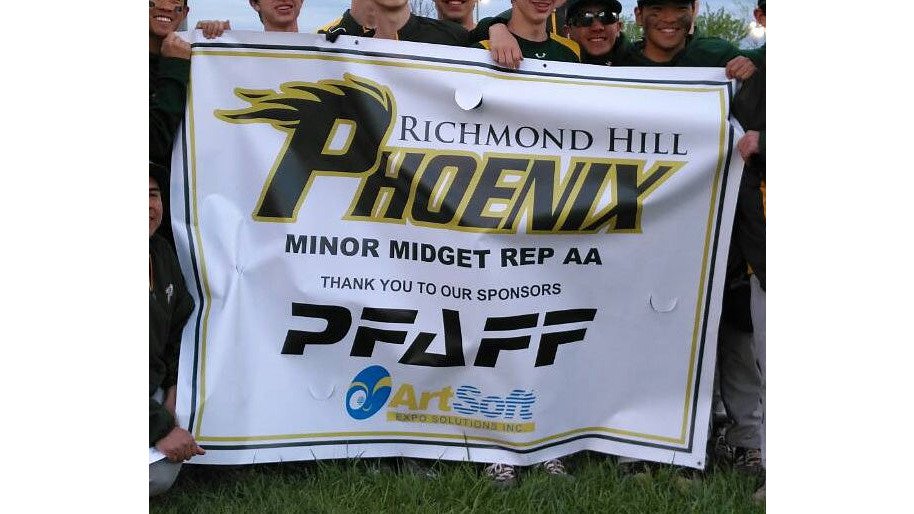
Sponsorship banners are the standard option. A sponsorship banner features donor or sponsor logos prominently, giving them visibility at games and fundraisers. To order, submit the team name, team logo in JPEG or PDF, and each sponsor logo in JPEG or PDF. The banner is printed on 13oz material with grommets every 60 cm (approximately 2 feet) on all four sides, so it can be zip-tied to fences or frames at the field.
How much do senior banners cost?
At Artsoft Expo Solutions Inc., a Player and Team Award Banner starts at $15.00, which makes senior recognition affordable for a full roster. The minimum order is 10 players and coaches, and you submit the team name, player name, player number, and team logo in PDF. Design is included and PDF proofs are provided before printing, so you can check spelling and numbers before the run.