

Graphicolor Exhibits Alternative for Corporate Events
Last Updated: October 23, 2026
Quick Summary
A graphicolor exhibits alternative for corporate events is best judged on hardware, lead times, and included services rather than sticker price. Artsoft Expo Solutions Inc. offers booth packages from $888.00, fabric popups from $995.00, and SEG systems from $1,430.00, with rush service starting at $200 per fabric.
- Booth Package 1 at $995.00 includes a hanging banner, two retractable banners, and a table throw.
- The 8ft Fabric Popup ships at 40 lbs and sets up tool-free with one person.
- Rush service on the 8ft Fabric Popup starts at $200 per fabric for 5 business days.
- Leave at least 0.3m (approximately 1ft) of clearance on each side of an 8ft wall in a 10x10 space.
- Score vendors on weighted criteria and mark unscorable items zero, not average.
Table of Contents
- Why Corporate Planners Seek a Graphicolor Exhibits Alternative
- Quick Comparison: Display Options for Corporate Events
- Portable Fabric Display Wall Size Guide
- Modular Display Systems for Corporate Events
- Custom Tradeshow Booth Design Services: What to Expect
- Total Cost Breakdown and What's Included
- How to Evaluate a Display Vendor Before You Switch
- Conclusion
- Frequently Asked Questions
Why Corporate Planners Seek a Graphicolor Exhibits Alternative
A Graphicolor Exhibits alternative for corporate events usually comes down to three practical pressures: tighter shipping windows, multi-city schedules, and hardware that a small team can set up without outside help. This guide from Artsoft Expo Solutions Inc. compares the options planners actually weigh when they start looking at a different display vendor.
The display industry rewards planners who plan backwards from the load-in door. If your graphics land two days before a show, the booth design stops mattering.
Below, we break down portable fabric walls by size, modular systems by schedule, and custom booth services by what they actually include. We also show where the total cost hides, so you can evaluate any vendor, including us, on the same terms.
Quick Comparison: Display Options for Corporate Events
Corporate event display options fall into four practical categories: portable fabric popup walls, complete booth packages, modular SEG systems, and custom-fabricated booths. Each fits a different booth footprint, shipping profile, and setup crew size.
| Option | Typical Setup | Best For | Starting Price (CAD) |
|---|---|---|---|
| Booth Package #2 | 20-30 min, 1-2 people | First-time exhibitors, tight budgets | $888.00 |
| Booth Package #1 | 20-30 min, 1-2 people | 10x10 booths needing a hanging banner | $995.00 |
| 8ft Fabric Popup | Minutes, tool-free, 1 person | Step-and-repeat backdrops, media walls | $995.00 |
| 7.5ft SEG Popup | 30-40 min, 1 person | Repeat shows, premium finish | $1,430.00 |
| SEG Counter | Under 15 min | Adding a branded reception point | $715.00 |
The spread matters more than the sticker. A package at $888.00 that includes a hanging banner, two retractable banners, and a table throw replaces four separate purchases.

Portable Fabric Display Wall Size Guide
A portable fabric display wall should match your booth footprint, not exceed it. For a standard 10x10 booth, an 8ft wide wall leaves walking room on both sides and still fills the back wall from most camera angles. Wider walls belong in 10x20 spaces or as room dividers.
Matching Wall Size to Booth Footprint
Start with the back wall. An 8ft straight fabric popup comes in 8ft wide by 7.5ft tall, 8ft wide by 10ft tall, and a curved 8ft by 7.5ft version.
For a 10x20 booth, two 8ft walls at an angle create a corner backdrop without a custom build. Curved frames soften the look and pull traffic inward, which helps at crowded shows where straight walls blend together.
Weight, Packing, and Shipping Considerations
Weight decides who sets up your booth. The 8ft Fabric Popup ships at 40 lbs in a 34" x 12" x 12" package.
Booth packages are lighter still. Both Booth Package #1 and Booth Package #2 ship at 26 lbs in a 40" x 12" x 5" box, which means one person can carry the entire booth from the loading dock.

Modular Display Systems for Corporate Events
Modular display systems for corporate events are reconfigurable frame-and-graphic setups that pack into cases and rebuild in different footprints at each venue. They suit teams attending several conferences a year because one purchase covers multiple booth layouts.
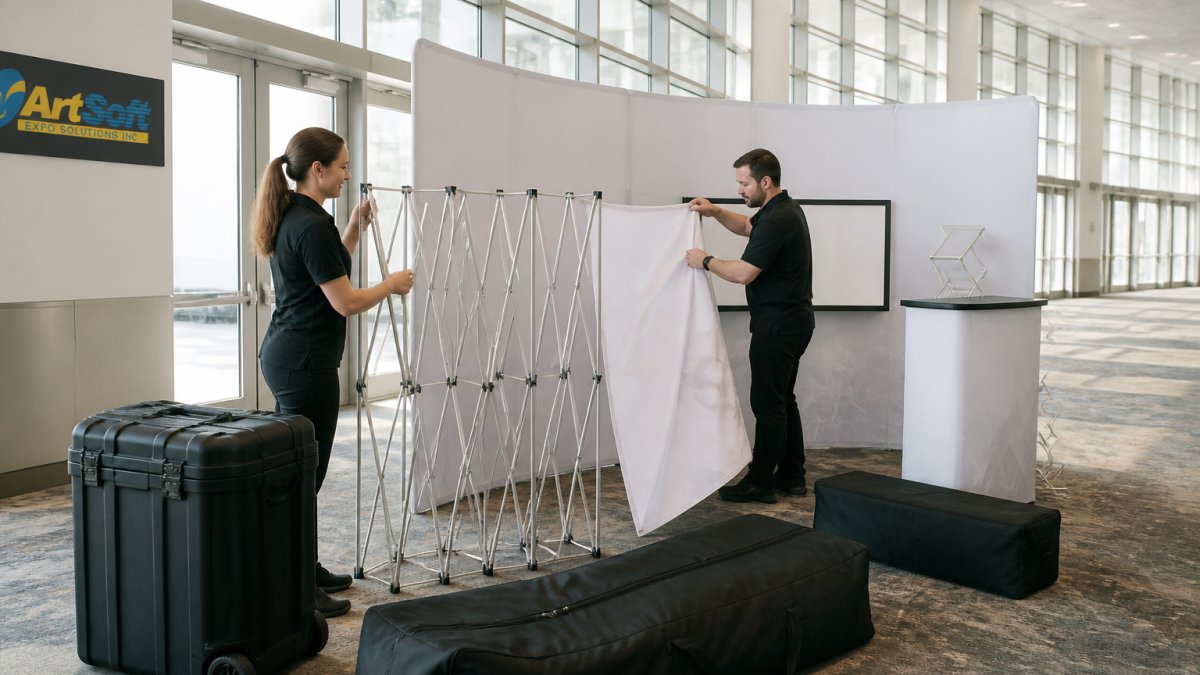
How Modular Configurations Handle Multi-City Schedules
The weak point in any multi-city schedule is the graphic-to-frame connection. Systems that rely on loose panels and separate hardware slow down every setup.
Rush options matter as much as the hardware. Artsoft Expo Solutions Inc. offers rush services on the 8ft Fabric Popup starting at $200 per fabric for a 5-business-day turnaround, up to $500 per fabric for next-business-day service.

Custom Tradeshow Booth Design Services: What to Expect
Custom tradeshow booth design services cover artwork preparation, print production, hardware supply, and sometimes installation support. What separates vendors is how much of that work is included in the quoted price and how early the artwork deadline falls.
A standard custom workflow runs in four stages:
- Artwork specification: the vendor supplies templates sized to each frame, including end caps and counter wraps.
- Proofing: you approve a digital proof before print.
- Production: fabric printing and hardware assembly, typically 5-8 business days on standard orders.
- Shipping: packed cases delivered to your venue or office.
Ask every vendor one question before you sign: does the quote include artwork setup, or is design billed separately? That single line item is where "affordable" display companies recover margin.
Matching Services to Corporate Event Types
A conference booth needs a back wall that reads from 20 feet and a counter for lead capture. A product launch needs a stage backdrop and a step-and-repeat that photographs cleanly under press lighting.
Most vendors quote the same package for all four. The better approach is to ask for a use-case brief: describe the event, the room, the audience, and the one action you want attendees to take.
Measuring Whether the Booth Worked
Design services should come with a measurement plan, not just a proof. Before the event, agree on three metrics: attendance at the booth or session, average dwell time, and leads or sign-ups captured.
If a vendor cannot tell you how its booth design is supposed to move those numbers, it is selling decoration, not event marketing. Ask for the measurement plan in writing as part of the quote.
Total Cost Breakdown and What's Included
Total cost for a corporate event display includes hardware, printing, shipping, rush fees, and any design charges. Comparing quotes on hardware alone hides the difference. Build a line-by-line comparison instead.
| Cost Line | What to Confirm | Typical Trap |
|---|---|---|
| Hardware | Frame, printed graphic, carry bag included | Frame quoted without graphic |
| Artwork setup | Template files and proof included | Design billed hourly after quote |
| Shipping | Destination, case dimensions, weight | Oversized freight surcharges |
| Rush fees | Published per-fabric rates | Undisclosed expedite charges |
| Replacement parts | Individual components sold separately | Full unit replacement required |
A Booth Package #1 at $995.00 includes a 111" x 84" fabric hanging banner, two RB33 retractable banners, and a 6ft open-back table throw. That is a complete 10x10 booth in one line item.
How to Evaluate a Display Vendor Before You Switch
Evaluate a display vendor on seven criteria: published lead times, rush service availability, included artwork support, hardware weight and setup requirements, geographic coverage for installation, accessibility and safety compliance, and sustainability practices. Score each out of five and let the total decide, but weight the criteria by what matters most to your event calendar.
- Lead times published per product, not "contact us"
- Rush options with stated per-unit pricing
- Artwork templates supplied for every frame size
- Setup crew size and time documented
- Shipping weight and case dimensions listed
- Replacement parts available individually
- Installation or on-site support available in your event cities
- Accessibility considered: counter heights, clear floor space, readable typography
- Safety documentation: flame-retardant certificates, stable weighting, cable management
- Sustainability: reusable hardware, recyclable graphics, take-back options
A Simple Scoring Model
Assign a weight to each criterion based on your schedule. If you attend six shows a year in three cities, lead time and geographic coverage should carry double weight. If you run internal events in leased office space, accessibility and safety documentation matter more.
This is also where you test the vendor's honesty. A vendor that publishes lead times and rush pricing is easier to score than one that answers "it depends." If a criterion cannot be scored because the information is not public, mark it zero, not average.
The Switch Itself
The switch should be low-risk. If your team already knows how to set up a popup frame, moving to a tension fabric system takes one rehearsal. If you are coming from a heavier custom booth, plan a single test setup before your first show with the new hardware. Confirm in writing who handles freight damage claims, what the replacement-part turnaround is, and whether installation support is included or billed hourly.
Conclusion
The real challenge with switching display vendors is not finding another supplier. It is finding hardware, lead times, and included services that hold up across a full conference calendar without surprise charges.
At Artsoft Expo Solutions Inc., we build lightweight, easy-to-assemble display systems with published lead times, rush services, and package pricing that lists what is included.
Get started with Artsoft Expo Solutions Inc. and walk into your next show with a booth your team can build in minutes.
Frequently Asked Questions
What are the different types of exhibit booths for corporate events?
Corporate events typically use three booth formats: portable popup displays with tension fabric graphics, modular systems built from interchangeable frames and panels, and fully custom-built booths for larger footprints. Portable popups suit 10x10 spaces and one-person setup, modular systems scale across multi-city schedules, and custom builds deliver the most distinctive brand presence. Many planners mix formats, using a popup backdrop for smaller shows and a modular configuration for anchor conferences.
What features should I look for in a portable fabric display wall?
Check four things: graphic attachment method, frame durability, packed weight, and lead time. Tension fabric graphics that stay attached to the frame during transport cut setup to minutes. A collapsible aluminum frame should lock firmly without tools. Packed weight matters for airline and courier costs; an 8ft popup at 40 lbs is manageable for one person. Confirm lead time against your event date, and ask whether rush production is available so a late approval does not leave you empty-handed.
Are modular display systems better than custom-built booths?
It depends on your event calendar. Modular systems win when you exhibit at several conferences a year: components reconfigure into different footprints, ship in fewer cases, and replacement parts are simple to source. Custom-built booths win when your brand needs a structure no catalogue product matches and you exhibit at the same anchor show repeatedly. A practical middle path is a modular frame with custom-printed fabric graphics, which gives brand distinction without the cost and lead time of full fabrication.
How do I choose a reliable tradeshow display vendor?
Ask for three references from clients with similar event volumes, then confirm what the quoted price includes: graphics, hardware, shipping, design files, and rush fees. Request the production lead time in writing and check whether rush services are priced upfront. Verify the vendor handles both hardware and large-format printing so you are not coordinating two suppliers. Finally, ask how replacement parts and reprints are handled after the first event, since that is where ongoing cost lives.
