

How to Avoid Tradeshow Shipping Delays: 2026 Guide
Table of Contents
- Why Tradeshow Shipping Delays Happen and What They Cost You
- The Tradeshow Freight Shipping Checklist Every Exhibitor Needs
- Common Tradeshow Shipping Mistakes That Cause Delays
- Customs Documentation for Event Materials Crossing the Border
- Packing, Crating, and Choosing the Right Shipping Cases
- How to Track Tradeshow Shipping in Real Time
- Emergency Plan: What to Do When Your Booth Materials Are Delayed
- Frequently Asked Questions
Last Updated: September 27, 2026
Why Tradeshow Shipping Delays Happen and What They Cost You
Learning how to avoid tradeshow shipping delays starts with understanding where shipments break down. A missed move-in window can leave your booth empty while buyers walk past. This guide from Artsoft Expo Solutions Inc. breaks down the full process, from carrier booking to post-show returns.
Most delays trace back to three causes: late booking, missing customs paperwork, and weak packing. Each one is preventable with planning.
The cost goes beyond freight. A delayed crate means rush labor, overtime drayage, and lost selling hours. Many exhibitors find that a single missed day costs more than the entire shipping budget for the show.
Below, we'll show you exactly how to build a shipping plan that holds up when something goes wrong.
The Tradeshow Freight Shipping Checklist Every Exhibitor Needs
A tradeshow freight shipping checklist keeps every deadline visible. Start with the exhibitor manual, then work backward from the show date.
Key Dates in the Exhibitor Manual
The exhibitor manual is the official show document listing move-in windows, advance warehouse deadlines, and drayage rules. Read it before you book anything.
Pull these dates out first:
- Advance warehouse receiving deadline
- Direct-to-show move-in window
- Empty crate storage cut-off
- Move-out and freight carrier check-in times
Missing the advance warehouse deadline usually means shipping direct-to-show. That costs more and leaves less buffer time.
Carrier Booking and Bill of Lading Basics
A bill of lading is the legal contract between you, the carrier, and the consignee. It lists the freight, the delivery address, and the booth number.
Book your carrier at least two to three weeks before the show. Confirm the consignee name and address match the exhibitor manual exactly. One wrong digit can send your crate to the wrong dock.
Common Tradeshow Shipping Mistakes That Cause Delays
The most common tradeshow shipping mistakes are small errors with big consequences. Here are the ones we see most often:
- Shipping to the wrong address or consignee name
- Missing or unreadable shipping labels
- No booth number on the crate
- Underestimating transit time
- Skipping buffer time between arrival and setup
- Forgetting weight tickets for freight class checks
Each mistake adds hours or days. A missing booth number can leave your crate sitting in a warehouse while the show floor opens without you.
Freight class errors matter too. Carriers price by freight class, and a wrong class can trigger a re-weigh fee or hold your shipment at the dock.
Customs Documentation for Event Materials Crossing the Border
Customs documentation for event materials must be complete before your freight reaches the border. Missing paperwork is the fastest way to stall a cross-border shipment, and a hold at the border rarely resolves in hours, it resolves in days.
You will typically need:
- A commercial invoice listing every item, its value, and its country of origin
- A packing list matching the crate contents line by line
- HS codes for each product category
- A carnet or temporary import bond, where applicable
- Proof of ownership or a statement that goods are for temporary exhibition use
HS Codes, Carnets, and the Customs Broker's Role
HS codes classify your goods for customs. Wrong codes slow clearance and can trigger tariffs or import duties you did not plan for. The risk is highest for mixed crates, a single pallet holding electronics, printed collateral, and booth hardware can span three or four HS chapters. Split the invoice by category rather than declaring the whole crate under one code.
A carnet (formally the ATA Carnet) lets you move exhibit materials across borders temporarily without paying duties or posting a bond at each crossing.
What Actually Stalls a Cross-Border Crate
A common pattern is not a missing document but a mismatched one. The invoice says 12 units, the packing list says 10, and the crate holds 11. That discrepancy alone can trigger an inspection. Other frequent stalls:
- Goods described as "samples" or "promotional materials" with no value declared
- Booth giveaways (pens, tote bags, food items) that are technically imports and may carry duty
- Lithium batteries in demo units, which face separate dangerous-goods rules
- Wooden crates without ISPM 15 heat-treatment stamps, which can be refused outright
Packing, Crating, and Choosing the Right Shipping Cases
Good packing prevents damage and speeds handling. Use crating and palletizing that match your freight class and transit conditions.
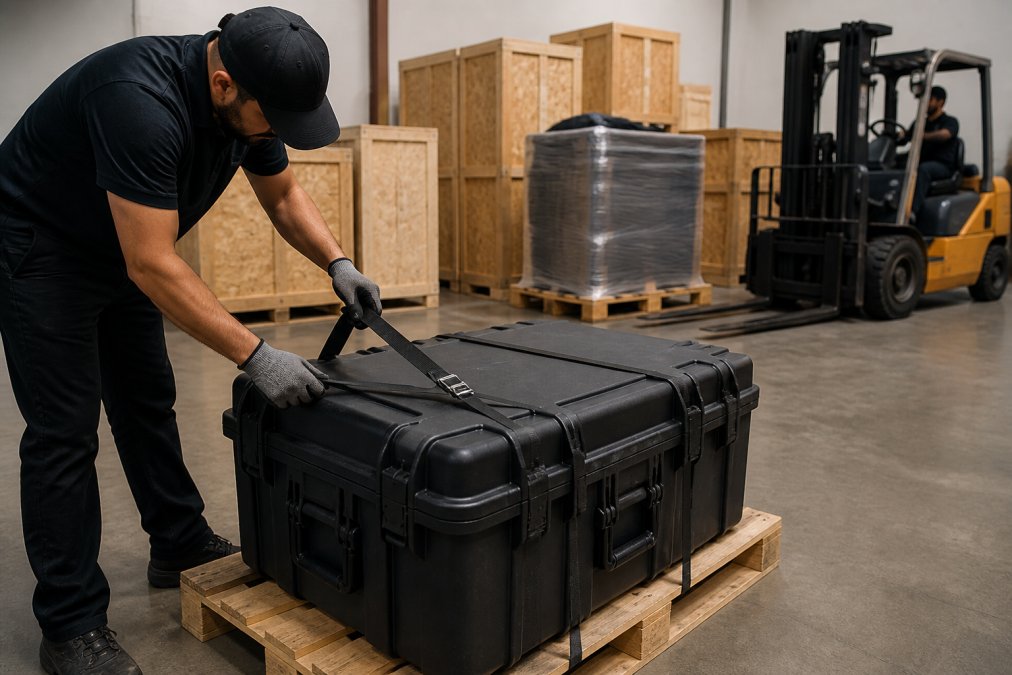
Palletizing and Labeling for the Advance Warehouse
Palletize heavy items at the bottom and light items on top. Keep the load stable and within weight limits.
Label every side of the crate with:
- Show name and booth number
- Consignee name and address
- Your company name and contact
- Crate number, if you ship multiple pieces
How to Track Tradeshow Shipping in Real Time
Real-time tracking turns a black box into a visible timeline. Ask your carrier for tracking numbers and share them with your logistics partner. But tracking numbers alone are passive, the exhibitors who avoid delays are the ones who set triggers and act on them.
Build a Tracking Stack, Not a Tracking Number
A single carrier tracking page is the floor, not the ceiling. A practical stack for a show shipment looks like this:
- Carrier tracking for the base layer, pickup, linehaul, border, delivery
- GPS-enabled crates or pallets for high-value or multi-leg moves, so you see location even between carrier scans
- A shared spreadsheet or freight-management dashboard that your logistics partner, broker, and booth lead can all see
- Calendar alerts tied to each checkpoint, not just the delivery date
Set Alert Thresholds, Not Just Alerts
An alert with no threshold is noise. Define what counts as a problem before the show:
- No scan movement for 12 hours during linehaul, call the carrier
- No border clearance update for 24 hours, call the broker
- No warehouse receipt confirmation 48 hours before the advance warehouse deadline, escalate to the show's freight desk
- No booth delivery 4 hours into your move-in window, trigger the emergency plan
The Reverse-Leg Gap Nobody Plans For
Most guides stop tracking when the crate hits the booth. The return leg is where shipments actually disappear, empty crates get stored, move-out windows compress, and return carriers get booked last. Track the reverse leg with the same stack:
- Confirm the empty-crate storage location and retrieval time before move-out day
- Book the return carrier before the show opens, not on move-out morning
- Set a scan-movement alert for the return pickup, because a missed return pickup can strand freight for days
- Photograph the crate and its contents at move-out, before it leaves the floor
Emergency Plan: What to Do When Your Booth Materials Are Delayed
Work through these steps:
- Confirm the delay with your carrier and get a new ETA
- Call the show's freight desk and ask about late move-in options
- Contact your customs broker if the hold is at the border
- Prepare a backup display if the main crate will not arrive
- Document everything for an insurance or liability claim
Post-show reverse logistics deserves the same planning as the outbound move. Book your return carrier before move-out day, or your empty crates may sit for days.
Frequently Asked Questions
What are the most common reasons for tradeshow shipping delays?
The biggest causes are missed deadlines in the exhibitor manual, incomplete customs paperwork for cross-border freight, and carriers running out of capacity during peak show season. Weather and port congestion add unpredictability. Most delays trace back to booking too late or shipping without a buffer. Aim to have freight arrive at the advance warehouse at least three to five business days before the move-in window opens.
What documentation is required to prevent customs delays for event materials?
You need a commercial invoice, a packing list, a bill of lading, and correct HS codes for every item. If you are shipping temporarily, an ATA Carnet simplifies the process by letting goods enter without paying import duties and tariffs. Work with a customs broker who handles event freight regularly, and make sure the consignee details match your booth number and show address exactly.
How can I track my tradeshow freight effectively?
Ask your carrier or logistics partner for tracking numbers at pickup, then monitor them daily against your shipping deadline. Many freight forwarders offer online dashboards with real-time location updates. Save the contact for your drayage provider and the advance warehouse so you can call directly if tracking stalls. Set calendar alerts for the move-in window and confirm delivery in writing before you travel.
What should I do if my booth materials are delayed?
Contact your carrier immediately to get a revised ETA and ask about expedited options. Call the show's general service contractor to ask about extended move-in hours or labor penalties. If hardware will not arrive, check whether the venue can print replacement graphics on site, or ship a backup banner stand directly to your hotel. Keep a digital copy of all artwork so you can reprint fast.
Tradeshow shipping delays are stressful, but they are rarely random. They come from late booking, missing paperwork, and weak packing, and each one has a fix. Artsoft Expo Solutions Inc. makes the hardware side simple with lightweight, easy-to-set-up displays, hard molded shipping cases, and fast shipping across North America. Get started with Artsoft Expo Solutions Inc. and send your booth to the next show with confidence.