

How to Transport Modular Trade Show Booths Safely
Table of Contents
- Why Modular Trade Show Booths Cut Shipping Costs and Setup Time
- Modular Trade Show Booth Shipping Cases: Choosing the Right Protection
- How to Pack Trade Show Displays for Freight Without Damage
- Trade Show Booth Logistics Best Practices for Multi-Show Schedules
- Labeling, Tracking, and Drayage: Keeping Modular Trade Show Booths Moving
- Common Mistakes That Damage Booth Hardware in Transit
- Conclusion
- Frequently Asked Questions
Last Updated: October 4, 2026
Why Modular Trade Show Booths Cut Shipping Costs and Setup Time
Modular trade show booths are display systems built from separate, interchangeable parts that pack into shipping cases.
At Artsoft Expo Solutions Inc., we build our hardware around that idea. Lightweight frames and tension fabric graphics mean a full booth fits into one or two cases, not a dedicated van.
The savings show up in three places:
- Drayage fees, which many venues bill by the hundredweight, drop when your shipment weighs less.
- Setup time falls because frames click together without tools.
- Labor costs shrink when one person can assemble the booth instead of a crew.
But the savings only hold if the booth survives transit.
Below, we cover case selection, packing, labeling, freight choices, and the mistakes that quietly destroy booth hardware between shows.
Modular Trade Show Booth Shipping Cases: Choosing the Right Protection
The right shipping case is the single biggest factor in whether your booth arrives intact. Modular trade show booth shipping cases fall into three families: hard molded cases, soft bags, and custom-built crates. Each suits a different exhibitor, load, and freight mode.
Hard Molded Cases: The Default for LTL and Air Freight
Hard cases win for anything moving through LTL freight, where your shipment shares a trailer and gets handled multiple times. A thermoformed polyethylene case absorbs that abuse.
A good hard case includes:
- Built-in wheels and a steel, rubber-grip handle
- Heavy-duty latches that stay shut under vibration
- Adjustable interior straps to hold hardware in place
That last point is the one most exhibitors ignore. Every molded case has a working load limit, usually lower than its physical volume suggests: a 50" x 28" x 12" case may hold a full pop-up frame and graphics, but pack it with solid aluminum extrusion and you can exceed the latch rating before it looks full.
Soft Bags: Only for Hand-Carried Graphics
Soft bags work for one thing: light fabric graphics carried in your own vehicle. They offer almost no protection against stacking pressure. If a pallet lands on a soft bag in an LTL trailer, the frame inside bends.
Custom Crates: When Standard Cases Do Not Fit
Custom crates make sense for oversized or irregular components, high-value hardware that justifies the cost, and repeated shipments on the same route where a reusable crate pays for itself over a season.
A custom crate is typically built from plywood or composite panels with foam-lined interior cradles cut to each component. The trade-offs are real:
- Weight. A plywood crate can weigh two to three times what a molded case of the same interior volume weighs, which raises drayage and freight costs.
- Cost. A one-off crate is usually more expensive than a molded case, but a reusable crate amortized across five or six shows can be competitive.
- Handling. Crates often lack wheels, so freight handlers need a pallet jack or forklift at both ends. Confirm the venue and your carrier can move a crate before you commit.
Matching the Case to the Load
Match the case to the load and the freight mode. Our Molded Case-48 measures 50" x 28" x 12" with an adjustable interior strap, holding a mix of frame sections and rolled graphics.

A simple decision rule: if the booth travels by LTL, air, or any mode where it will be stacked, use a hard case or crate. If it travels in your own vehicle and you handle it yourself, a soft bag is acceptable for graphics only.
Transport Canada guidance on secure cargo
How to Pack Trade Show Displays for Freight Without Damage
Packing a display for freight comes down to three rules: clean everything first, protect every surface, and stop movement inside the case.
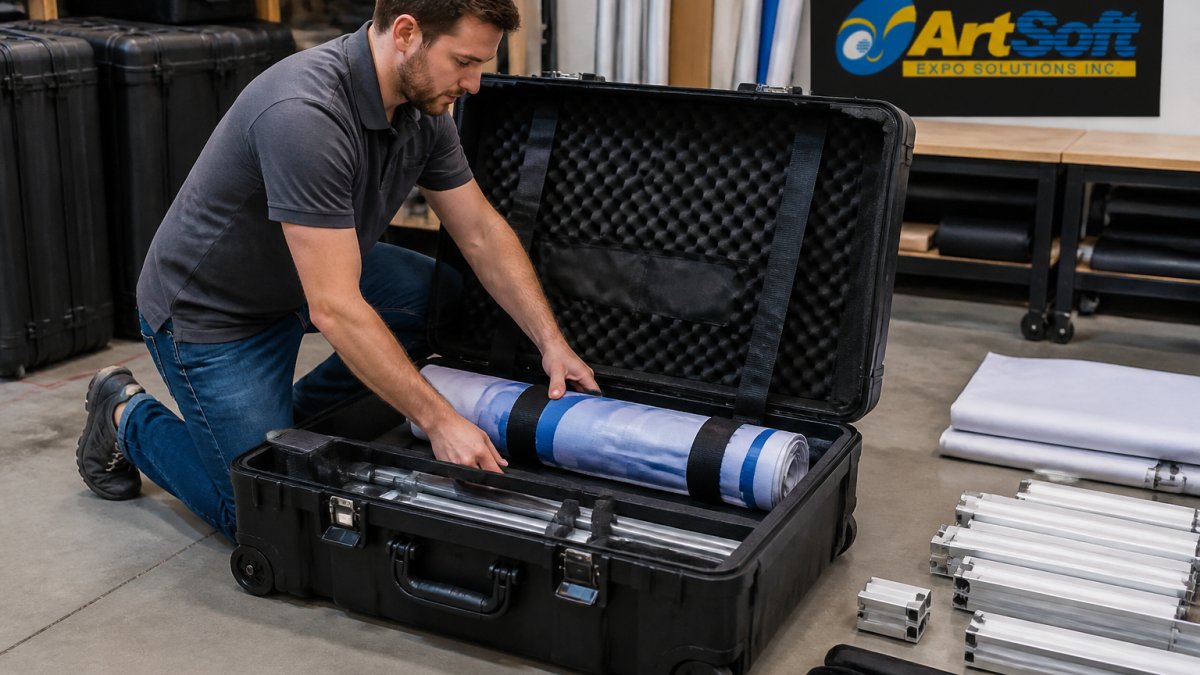
Start with the frames: wipe them down so grit does not grind into the finish, wrap each section in bubble wrap or foam, then bundle matching lengths with Velcro straps.
Roll tension fabric graphics, never fold them. Roll graphics around a cardboard tube, then slide them into a graphics tube or the case's dedicated compartment.
Step-by-Step Packing Checklist
- Clean and dry all frames, rails, and connectors
- Count every part against your booth inventory list
- Wrap each frame section in foam or bubble wrap
- Bundle same-length sections with Velcro straps
That last step matters: a photo proves how the booth left your hands if a damage claim comes up later.
Trade Show Booth Logistics Best Practices for Multi-Show Schedules
Running several shows a season changes the math. When your booth moves five or six times a year, logistics become a system, and the exhibitors who do this well treat the booth like a small freight program.
Build a Booth Inventory and Case Manifest
Build a booth inventory list and keep a copy inside every case, so a missing part surfaces at the next setup instead of on the show floor. Then create a case manifest: a one-page document listing every case number, contents, packed weight, and dimensions. The manifest does three things:
- It lets a carrier or venue handler confirm all pieces arrived without opening every case.
- It gives you the numbers you need to book freight accurately.
- It becomes the basis for a damage claim if something arrives broken.
Standardize Cases, Labels, and Packing Order
Standardize your cases. When every case uses the same latch and label system, your team packs faster and makes fewer errors, even when different staff handle different shows. Standardize the packing order too, heaviest items at the bottom, graphics rolled and strapped, foam filling every gap, and tape a written procedure inside each lid so a new hire can pack correctly on the first try.
Choose the Right Freight Mode for Each Leg
Multi-show schedules usually mix freight modes. The three you will encounter most often are:
- Parcel and courier. Best for one or two light cases moving short distances. Fast and simple, but expensive per pound and rarely the right choice for a full booth.
- LTL (less-than-truckload). The default for most modular booths. Your freight shares a trailer, so it is cheaper than a dedicated truck but gets handled more. Hard cases are essential here.
- Dedicated truck or van. Reserved for high-value booths, tight schedules, or shows where you need the booth to arrive at a specific hour. The most expensive option, but the least handling risk.
A common pattern is parcel for graphics and small parts, LTL for the main cases, and a dedicated vehicle only when a show's move-in window is tight. Book LTL early: capacity tightens before major show seasons and last-minute bookings cost more.
Plan the Turnaround Between Shows
Track your turnaround time. Note how long packing takes at each show. If it creeps up, something in your process is slipping. Build a simple calendar that works backward from each show's move-in date:
- Move-out date from the previous show
- Transit days to the next city
- Warehouse or storage window, if the booth is not going straight to the next venue
- Move-in date and drayage deadline at the next show
If two shows are back-to-back in different cities, the booth may need to ship directly from one venue to the next. Confirm with both venues and your carrier that direct-to-next-show shipping is allowed, because some venues require freight to leave the dock by a set time.
Cross-Border and International Legs
For shows that cross a border, confirm your paperwork early: commercial invoices, customs documentation, and carrier bonds all take time to arrange, and a missing form can hold your booth at the border while the show floor opens without you. If the booth returns home after the show, ask your carrier about a carnet or temporary admission process to reduce duties and simplify re-entry.
DIY Freight vs. Professional Carriers: Pros and Cons
DIY freight (you drive it)
- Pros: Full control, no carrier damage risk, flexible timing
- Cons: Only works for regional shows, vehicle space limits booth size, driver time adds up
Professional carriers
- Pros: Reaches any show, handles long distances, shifts liability to the carrier
- Cons: Requires careful packing, damage claims take time, LTL handling adds risk
For local shows within driving distance, DIY often wins. For anything requiring air or long-haul trucking, a professional carrier is the only realistic option. Insure the shipment either way and confirm the carrier's liability limit before you book, since standard coverage is often lower than the replacement value of a full booth.
Labeling, Tracking, and Drayage: Keeping Modular Trade Show Booths Moving
Drayage is the fee venues charge to move your freight from the loading dock to your booth space. It is also where shipments get lost. Good labeling prevents both problems.
Label every case on two sides with:
- Your company name and booth number
- The show name and move-in date
- A contact phone number
- The case number, such as "1 of 3"
Numbering cases tells handlers how many pieces belong to your shipment. If one goes missing, you know immediately.
Track every case with a carrier tracking number, and photograph the labeled case before it leaves.
Common Mistakes That Damage Booth Hardware in Transit
Most transit damage traces back to a handful of repeat mistakes. Fix these and your hardware lasts for years.
- Folding fabric graphics. Folds crease the print. Always roll.
- Leaving empty space in the case. Contents shift, collide, and crack. Fill every gap with foam.
- Overloading one case. A case packed past its weight limit fails at the latches. Split the load instead.
- Reusing worn straps. A stretched strap lets hardware move. Replace them when they fray.
Conclusion
Every exhibitor faces the same gap: the booth works in the show hall, but the trip between shows is where hardware fails. Closing it takes the right cases, a repeatable packing routine, and clean labeling.
Artsoft Expo Solutions Inc. builds hardware for exactly that reality. Our lightweight, easy-to-assemble displays ship fast across North America, and our molded shipping cases, including the Expandable Case and Medium Podium Case II, protect your investment between shows.

Get started with Artsoft Expo Solutions Inc. and send your next booth down the road with hardware that arrives ready to set up.
Frequently Asked Questions
What is the best way to pack a modular trade show booth for shipping?
Start by disassembling the frame and wrapping each piece in bubble wrap or foam. Place heavier components at the bottom of a hard case and use adjustable straps to secure them. Roll tension fabric graphics loosely around a tube to prevent creases. Fill empty spaces with padding so nothing shifts during transit. Label the case clearly with your company name and booth number. For extra protection, a molded case like the Molded Case-48 offers thermoformed polyethylene construction and built-in wheels.
Do modular trade show booths require specialized freight services?
Not always. Many modular booths ship fine via standard LTL freight or even courier services if the cases are under weight limits. However, if your booth includes large hanging structures or multiple heavy cases, a specialized freight carrier with liftgate service may be necessary. For international shows, customs brokerage and proper documentation become essential.
How can I reduce shipping costs for trade show displays?
Use lightweight modular hardware and compact shipping cases to lower dimensional weight. Book LTL freight early to avoid rush fees. Choose cases with built-in wheels to avoid forklift fees.
What are the common risks when transporting modular booth hardware?
The biggest risks are shipping damage from improper packing, lost or mislabeled cases, and drayage delays at the venue. Frame pieces can bend if not secured, and fabric graphics can crease or tear. To prevent these, use hard cases with foam inserts, label every case with your booth number and contact info, and keep a detailed inventory list. Photograph the packed cases before shipping for insurance claims. Also confirm your carrier's liability coverage before the show.