

How to Build Custom Branded Event Display Solutions
Last Updated: November 10, 2026
Quick Summary
Custom branded event display solutions are modular hardware and printed graphics built to carry one brand identity across every show, conference, and retail activation. Artsoft Expo Solutions Inc. manufactures them and supplies them across Canada. Choose a system two people can assemble in under fifteen minutes and pack into a case one person can lift.
- A modular system spreads its cost across every show it attends, unlike a one-show build.
- SEG frames let you refresh graphics without replacing the hardware.
- Lightweight aluminum frames cost less to ship because transit fees follow weight.
- Label every case and frame piece, and pack graphics separately from hardware.
- Production clocks start at artwork approval, not at order.
Table of Contents
- Choosing Custom Branded Event Display Solutions That Earn Their Floor Space
- Modular Trade Show Booth Design and Why It Outlasts One-Show Builds
- SEG Backlit Fabric Displays for Booths That Read From Across the Hall
- Portable Exhibit Booth Setup Tips for Tighter Schedules
- Comparing Display Options: Costs, Lead Times and What Each One Is For
- Measuring ROI and Planning Post-Event Storage and Maintenance
- Ordering Your Display Package With Artwork Approved in Time
- Frequently Asked Questions
Choosing Custom Branded Event Display Solutions That Earn Their Floor Space
Custom branded event display solutions are modular hardware and printed graphics built to carry one brand identity across every show, conference, and retail activation. Artsoft Expo Solutions Inc. manufactures them and supplies them across Canada. The decision that matters most is not which stand looks best in a catalogue photo, but which system survives five teardowns a year without your team losing an afternoon to setup.
Apply this test to any display: can two people assemble it in under fifteen minutes, does it pack into a case one person can lift, and can you replace a single graphic without buying new hardware? Fail any of those and it becomes a storage problem with a logo on it.
Three things decide whether a display earns its floor space:
- Reuse count. A one-show build amortizes over one event. A modular system spreads its cost across every show it attends.
- Graphic swap cost. Hardware should outlive several graphic refreshes.
- Transit weight. Shipping and drayage fees follow weight, and lightweight aluminum frames cost less to move.
The rest of this guide compares the main display types, their lead times, and the practical details that decide whether a package works at your booth. For a ready-made starting point, see our Booth Package #1, which bundles a hanging banner, two retractable stands, and a table throw.

Modular Trade Show Booth Design and Why It Outlasts One-Show Builds
A modular trade show booth design is a system of interchangeable frames, connectors, and printed panels that reconfigure into different footprints without new fabrication.
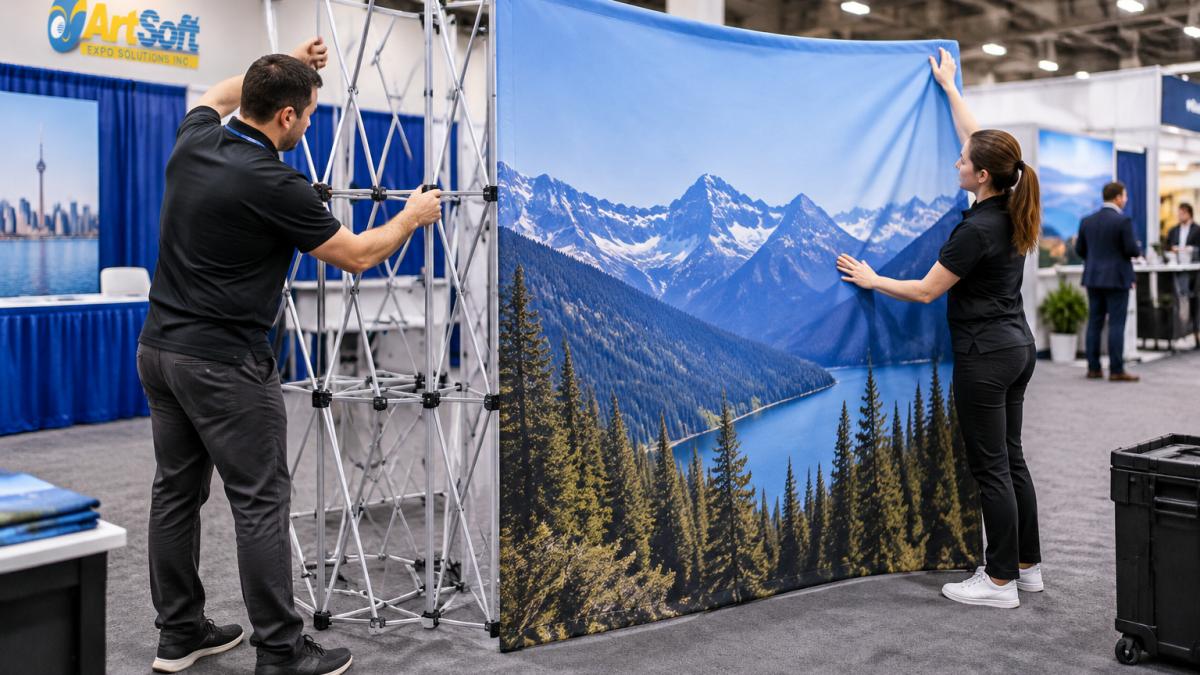
One-show builds get measured, welded, printed, then stored or scrapped. A modular system gets reconfigured: a 10x10 becomes a 10x20 by adding frames, not by starting over.
The practical difference shows up in three places: layout flexibility when the organizer assigns a different footprint, replacement cost when one panel is damaged in transit, and storage volume between events. Modular hardware breaks down flat; custom carpentry does not.
What separates a real modular system from a kit that only looks modular is the connector architecture. Most systems on the market fall into three families:
- Push-button and click connectors. Aluminum tubes with internal spring pins that lock into corner nodes. Setup is tool-free and repeatable, and the same frame can build a backwall, a tower, or a counter depending on which nodes you use. This is the family most rental houses and national exhibitors standardize on because a replacement tube costs a fraction of a custom panel.
- Silicone-edge (SEG) frames. Printed fabric is pushed into a groove around an aluminum profile. The frame is the structure and the graphic is the skin, so a graphic refresh does not touch the hardware. SEG frames reconfigure by swapping profiles and adding extrusions, which makes them strong for backwalls and lightboxes but less flexible for overhead structures.
- Tension-fabric popups. A collapsible frame with velcro-attached fabric. These are the fastest to set up and the least expensive per square foot, but they are purpose-built for a specific footprint and reconfigure less freely than a tube-and-node system.
If you are weighing the two approaches on cost, our breakdown of why modular booths are cost effective works through the numbers before you commit.
SEG Backlit Fabric Displays for Booths That Read From Across the Hall
SEG backlit fabric displays use silicone-edge graphics pushed into a recessed aluminum frame over pre-installed LED edge lighting. The result is a double-sided illuminated panel with no visible frame line and no hot spots.
Our SEG Lightbox Stand ships with LED edge lights pre-installed on the spine of the 80mm profile, a tool-less frame, and two printed graphics for double-sided use. Setup involves pushing the silicone edges into the grooves. The display measures 39 3/8 inches wide by 79 1/8 inches high and ships at 20 lbs in a 45" x 6" x 13" case.
To see the hardware and order a unit, view the SEG lightbox stand.

Portable Exhibit Booth Setup Tips for Tighter Schedules
Portable exhibit booth setup tips come down to one principle: rehearse the assembly before you leave the shop, not on the show floor at 7 a.m.
- Label every case and frame piece. Unmarked poles cost ten minutes each on a loading dock.
- Bring the right tools. Most tension fabric systems are tool-free by design; confirm before you pack.
- Time the first assembly. If it takes twenty minutes in your warehouse, budget thirty on site.
- Pack graphics separately from hardware. A scratched graphic is a rush order.
- Keep a spare banner in the case. A single retractable stand is the cheapest insurance in the kit.
Our 10ft Fabric Popup keeps its tension fabric graphic attached to the frame with velcro hooks even when packed, so setup is expand, lock, and done.
For a deeper walkthrough aimed at lean budgets, read our portable display setup guide for small budgets.
Comparing Display Options: Costs, Lead Times and What Each One Is For
Pricing and lead time decide as much as the visual does. The table below compares our core display types on the criteria that affect a show calendar.
| Display | Starting Price (CAD) | Standard Lead Time | Best For |
|---|---|---|---|
| RB33 Retractable Banner Stand | $179 | 3-4 business days | Retail promotions, presentations, secondary booth graphics |
| Flag Banner HD - Teardrop | $220 | 5-7 days | Outdoor visibility, entrance wayfinding |
| Popup Fabric Counter - Oval | $599 | 7-10 days | Converting booth space into a greeting point |
| Booth Package #1 | $995 | 5-7 business days | First-time exhibitors needing a complete 10x10 |
| 10ft Fabric Popup | $1,095 | 5-8 business days | Backwall and step-and-repeat backdrops |
| SEG Lightbox Stand | $1,355 | Quoted at order | Illuminated double-sided centerpieces |
| Canopy 10x10 - Package B | $1,790 | 10-12 business days | Outdoor events and shaded activation space |
| Circle Hanging Sign | $2,600 | 5-8 business days | Overhead brand visibility above a crowded hall |
Starting Price (CAD)
Measuring ROI and Planning Post-Event Storage and Maintenance
ROI on a display is a function of uses, not impressions. Track cost per show by dividing the total package price by the number of events it attends, then compare that to the qualified conversations logged at each one.
A simple framework we would use:
- Log total package cost, including shipping and any rush fees.
- Count the shows the system attends in a year.
- Record qualified leads per show, meaning conversations that produced contact details.
- Divide cost by total qualified leads to get cost per lead.
- Re-run the number after each graphic refresh, since the hardware cost drops out.
The step most teams skip is step five.
Store fabric graphics in the case they shipped in. Machine-washable fabric components, including the table throws in our packages, can be washed.
A maintenance calendar that works:
- Before every show: inspect connectors, check for bent tubes, confirm all cases and pieces are present.
- After every show: wipe frames, roll graphics, log any damage while it is fresh.
- Twice a year: full assembly rehearsal, replace worn velcro or silicone edges, refresh any graphic that has faded.
- Annually: review the cost-per-lead trend and decide whether a graphic refresh or a hardware addition is the better spend.
Ordering Your Display Package With Artwork Approved in Time
Artwork approval is the most common cause of a missed show deadline. Production clocks start at approval, not at order, so a proof sitting unread in an inbox is the real bottleneck.
Our artwork requirements are specific. Supply files at actual size, 150 dpi, in CMYK, as PDF, TIFF, or JPEG. Every order receives a digital proof before printing. For the RB33, regular production runs 3-4 business days after approval, and same-day production requires artwork approved by 11 a.m. Eastern Time, subject to availability. Production time does not include shipping transit, which depends on destination.
A realistic countdown for a show three weeks out:
- Week 1: finalize booth layout and confirm the organizer's footprint and electrical service.
- Week 2: submit artwork, review the proof within 24 hours, approve.
- Week 3: production, shipping, and a warehouse rehearsal of the full assembly.
If your files are not print-ready, our guide to preparing files for large format printing covers bleed, resolution, and color mode before you submit.
Building a display calendar that holds up across five or six shows a year is a hardware decision before it is a design decision. Artsoft Expo Solutions Inc. manufactures modular expo booths, SEG backlit fabric displays, retractable banners, and large-format printed graphics. Our lightweight systems are designed for easy setup, our catalogue covers everything from a $179 banner stand to a full booth package, and every order includes a digital proof before anything prints. Get started with Artsoft Expo Solutions Inc. and build a display kit that pays for itself across every event on your calendar.
Frequently Asked Questions
What are the most effective custom branded event display solutions for small businesses?
Start with pieces that cover more than one job. A retractable banner stand at $179 gives you a branded backdrop for a table, a retail entrance or a presentation, and packs into a 9 lb bag. Add a table runner at $70 and the same booth reads as finished. If you exhibit more than twice a year, Booth Package #1 at $995 bundles a hanging banner, two retractable stands and a table throw, so you buy the full look once instead of assembling it piece by piece.
How do SEG backlit fabric displays improve trade show booth visibility?
A backlit display puts light behind the graphic instead of bouncing it off the front, so colors stay saturated in dim halls and the panel reads from further away. The SEG Lightbox Stand uses pre-installed LED edge lights on an 80mm aluminum profile and ships with two double-sided printed graphics, so both faces of the booth work. Setup is tool-free: the silicone edge of the fabric pushes into the frame groove. It measures 39 3/8 inches wide by 79 1/8 inches high and weighs 20 lbs shipped.
What turnaround time should I expect for custom displays before an event?
Plan around production plus shipping, because production clocks do not include transit. Retractable banner stands run 3 to 4 business days after artwork approval, and rush production is available for an additional fee. Booth Package #1 takes 5 to 7 business days, the fabric popup 5 to 8, and the canopy 10 to 12. Every order gets a digital proof first, and the clock starts only once you approve it, so slow artwork approval is the most common cause of a late graphic.
Are modular expo booths a cost-effective choice for frequent exhibitors?
Yes, when the same hardware has to survive several shows a year. A modular system like the 10ft Fabric Popup keeps its tension fabric attached to the collapsible aluminum frame with velcro hooks even when packed, so you expand, lock and you are done, with no tools and no rehanging. Replaceable graphic panels mean a rebrand or a new campaign costs a print, not a new booth.
