

Tension Fabric Displays vs Rigid Foam Boards for Trade Shows
Last Updated: November 12, 2026
Quick Summary
Tension fabric displays use a dye-sublimated fabric graphic stretched over a reusable aluminum frame, giving you a wrinkle-free wall that packs into a soft case and sets up in minutes without tools. Rigid foam board is cheaper per piece at $8.00 for a 5 mm photo print, but it is single use, prone to dents and glare, and needs a flat crate for shipping.
- A full 2.4 m fabric wall packs into a case measuring 135 x 36 x 20 cm at 18 kg.
- The 2.4 m Fabric Wall Flex II is listed at $1,050.00 with frame, graphic, and case.
- Foam board's glossy facer reflects venue lighting and can wash out contrast.
- Fabric frames assemble with push pins and require no tools.
- Ask the venue for its written display-material requirement before you ship.
Tension Fabric Trade Show Displays: What They Are and How They Work
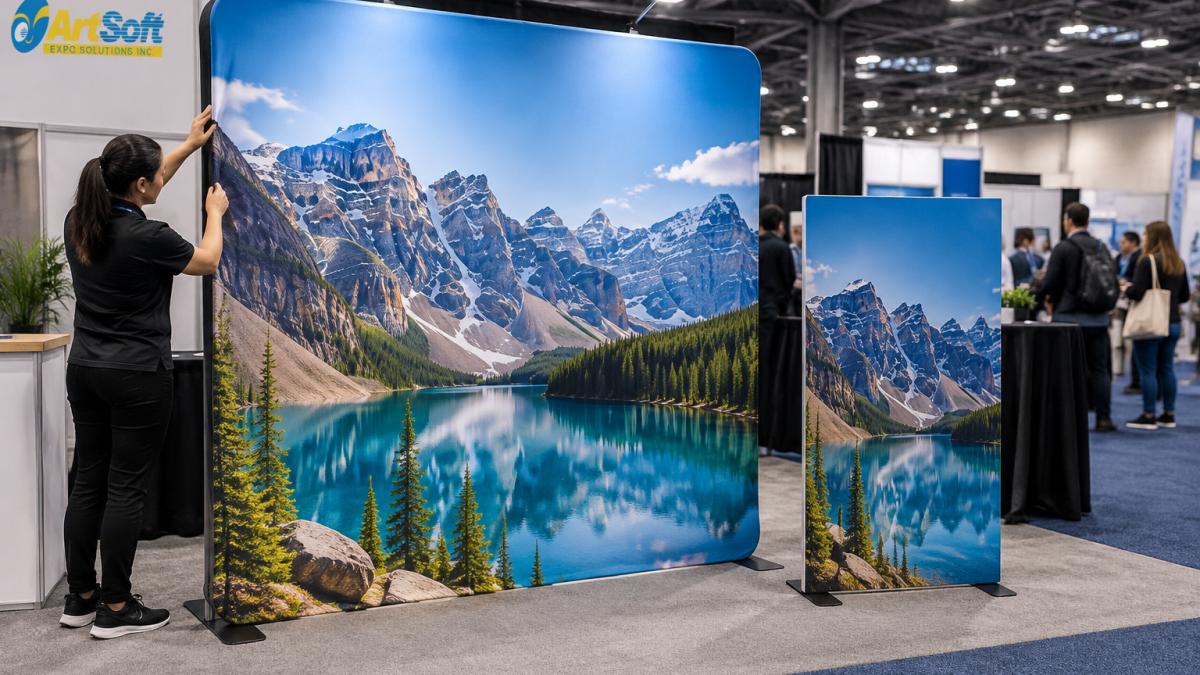
Tension fabric displays are aluminum frame systems wrapped in a printed fabric graphic that stretches taut, creating a seamless, wrinkle-free wall. Artsoft Expo Solutions Inc. offers pillowcase-style fabric displays, where dye-sublimated fabric zips over the frame and the tension holds it in place.
The mechanics matter more than the marketing. A tubular aluminum frame assembles with push-pin connectors, the graphic slides on like a fitted sheet, and the whole thing packs into a soft case. The 2.4 m Fabric Popup uses an accordion-style aluminum frame, and its fabric graphic stays attached to the frame with velcro hooks when packed away.

That construction is why fabric has displaced rigid panels in most booth designs. A crease in fabric steams out. A crease in foam board is permanent.
Foam Board Trade Show Signs: Strengths and Limitations
Foam board is a lightweight, rigid substrate printed directly with your artwork. It is genuinely good at short-run signage: sharp detail, low cost per piece, and it lies flat without any frame at all. The 5 mm foam board photo print is listed at $8.00.
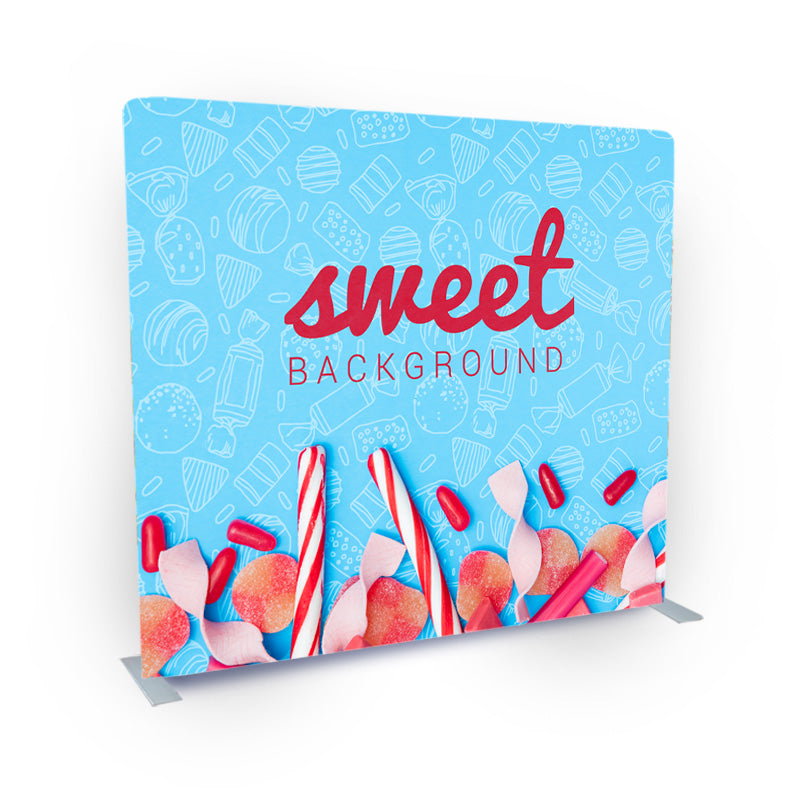
Where it struggles is the show floor.
Side-by-Side Comparison: Tension Fabric vs Rigid Foam Board
Most comparisons pit fabric against pop-up or broadly defined rigid displays. This one is like-for-like against foam core board specifically, because that is the decision most exhibitors are actually making.
Technical specifications
| Specification | Tension Fabric Display | Rigid Foam Board |
|---|---|---|
| Typical substrate | Dye-sublimated polyester knit, stretched over aluminum tube frame | Polystyrene foam core with paper or clay-coated facers, direct-printed |
| Common thickness | Graphic 8-12 mil; frame tube 25-38 mm | 5 mm and 12.5 mm are the common show grades |
| Weight, 2.4 m wall | Roughly 16-20 kg including frame and case | Roughly 4-7 kg per 1.2 x 2.4 m panel, plus crate weight |
| Print resolution | 150-300 DPI at final size is typical for dye-sublimation | 720-1440 DPI on direct flatbed is common |
| Surface finish | Matte knit, low glare | Gloss or satin facer; gloss reflects venue lighting |
| Lifespan | Frame reusable for years; graphic reusable across many shows with care | Single use in most cases; corners dent and facers warp |
| Setup time | Minutes, tool-free push-pin frame | Instant to place, but no frame and no structural rigidity |
| Packed footprint | Soft case, roughly 135 x 36 x 20 cm for a 2.4 m wall | Flat crate, full panel footprint, no folding |
| Graphic replacement | New pillowcase graphic only | New board each time |
| End of life | Aluminum frame recyclable; fabric graphic removable | Foam core is difficult to recycle in most municipal streams |
Lighting, glare, and color performance
Venue lighting is where the two materials behave most differently. Foam board's coated facer is smooth and often glossy, so overhead halogens and LED spots bounce straight back at viewers, washing out contrast and creating hot spots on large panels. Fabric knit absorbs and diffuses light, which is why a tension fabric wall reads cleanly from across an aisle even under mixed lighting.
Total cost of ownership over several events
| Cost line | Tension Fabric (2.4 m wall) | Foam Board (comparable 2.4 m run) |
|---|---|---|
| Initial system | $1,050.00 for frame, graphic, and case | Roughly $8.00 per 5 mm photo print piece; a full 2.4 m run of panels plus a flat crate runs into the hundreds |
| Replacement graphic per show | A fraction of the system price | New boards each show |
| Shipping | Soft case ships as standard luggage | Flat crate, dimensional weight, damage risk |
| Storage | Shelf or closet | Flat, dry, dust-free space |
| Labor | Minutes of setup | Handling and inspection each show |
| Reuse | Frame and graphic reusable across many events | Single use in most cases |
Environmental and end-of-life comparison
If sustainability is part of your booth story, ask suppliers for material composition and end-of-life guidance rather than relying on general claims.
Reusable Trade Show Graphics: Cost and Longevity Factors
Reusable trade show graphics change the math on every event after the first. The 2.4 m Fabric Wall Flex II is listed at $1,050.00 and includes the aluminum frame, the pillowcase graphic, and a carrying case.
If you are weighing the long-run economics, our guide on why modular booths are cost effective walks through the numbers.
Portable Trade Show Displays: Transport, Setup, and Venue Compliance
Portability is where tension fabric displays separate themselves. A full 2.4 m wall packs into a case measuring 135 cm high by 36 wide by 20 deep, at 18 kg. Foam board panels of the same size need a flat crate and careful handling.
Fabric frames assemble with push pins and no tools.
Venue compliance checklist
Venue compliance is the part exhibitors forget, and it is the gap most comparison articles leave open. Confirm the display material requirements with the venue before you ship. Confirm the following:
- Ask the venue for its written display-material requirement, including any flame-spread standard it cites.
- Request documentation from your supplier for the specific fabric or foam board you are using, not a generic certificate.
- Keep the documentation with the case so it is on hand at load-in.
- Confirm whether the venue requires a sample of the material for inspection.
- Check any height, anchoring, or aisle-clearance rules that affect a 2.4 m or 3 m wall.
- Confirm whether foam board secondary signage needs the same documentation as the main display.
Watch out: a certificate for one fabric does not cover a different graphic or a different substrate, so match the paperwork to the exact materials on the truck.
Transport and handling specifics
For transport and handling detail, see our guide on how to transport modular trade show booths safely.
Choosing the Right Display for Your Booth: Next Steps with Artsoft
Match the display to your show calendar, not to a single event. If you exhibit once and never again, foam board is a reasonable, low-cost choice for small signs. If you exhibit repeatedly, a tension fabric system pays for itself through graphic replacement alone.
Booth size helps decide format. A 3 x 3 m space suits a 2.4 m popup, and larger footprints can use a 3 m wall.
We offer both fabric displays and foam board photo prints. Lead times vary by product; the 2.4 m Fabric Wall Flex II lists 8 to 10 business days. If you are still comparing suppliers, our guide on choosing tradeshow booth vendors covers what to ask before you commit.
The real risk is buying for one show and paying for it at every show after. Artsoft Expo Solutions Inc. manufactures lightweight aluminum-frame displays with dye-sublimated fabric graphics, ships across North America, and offers rush production when a show date moves up. Get started with Artsoft Expo Solutions Inc. and build a booth that travels as well as your team does.
Frequently Asked Questions
What is the difference between a tension fabric display and a foam board display?
A tension fabric display uses a lightweight aluminum frame with a dye-sublimated fabric graphic stretched over it, often with a pillowcase or SEG design. A foam board display is a rigid panel, typically 5 mm or 12.5 mm thick, printed directly on one side. Fabric displays include a carry case in the listed packages.
Are tension fabric displays better than rigid foam boards for trade shows?
Tension fabric displays are tool-free to set up and include a carrying case. The 2.4 m Fabric Wall Flex II is listed at $1,050.
Can tension fabric graphics be reused for multiple events?
Yes. Fabric graphics are wrinkle-free stretch fabric that can be easily cleaned and steamed. The 2.4 m Fabric Popup, for example, keeps the graphic attached to the frame with velcro hooks even when packed, so you can expand and lock it in minutes.
How durable are foam board trade show signs?
Foam board is lightweight and rigid but not built for repeated transport. The 5 mm and 12.5 mm foam board photo prints are lightweight and rigid, and are listed for presentations, retail signage and events.
Which display option is better for a small trade show booth?
A portable fabric display such as the 2.4 m Fabric Popup ($995) fits a 3 x 3 m booth and packs into a bag measuring 86 x 30 x 30 cm, making it easy for one person to transport and set up.
