

Vinyl vs Mesh Banners for Outdoor Use: Which Handles Wind
Last Updated: October 26, 2026
Quick Summary
Mesh banners are perforated so wind passes through instead of pushing against the fabric, making them the better choice for fences, scaffolding and building faces where vinyl would tear or pull loose. Choose solid vinyl for walls, storefront windows and indoor backdrops, where it gives sharper detail at a lower entry price.
- Wind force rises with the square of wind speed and linearly with surface area.
- On exposed sites, space grommets every 0.5 to 0.6 metres and use stitched, reinforced hems.
- Our 8oz mesh banner starts at $6.00; 13oz vinyl starts at $3.00.
- Mesh perforations let light and silhouettes through, keeping hoarding and fencing looking open.
- Size text at roughly 2.5 cm of letter height per 3 metres of viewing distance.
Table of Contents
- Vinyl vs Mesh Banners: The Short Answer
- How Vinyl and Mesh Banners Are Made
- Wind Resistance and Airflow: Where Mesh Banners Win
- Weather, Sun and UV: Durability and Outdoor Lifespan
- Print Quality, Color Vibrancy and Visibility Through Mesh
- Custom Banner Printing Costs and Total Cost of Ownership
- Large Format Printing Best Practices for Outdoor Banners
- Ordering Outdoor Banners From Artsoft Expo Solutions Inc.
- Frequently Asked Questions
Vinyl vs Mesh Banners: The Short Answer
Vinyl banners vs mesh banners for outdoor use comes down to one question: does the wind need somewhere to go? Solid vinyl blocks airflow and catches every gust, suiting short-term, sheltered placements.
Our short verdict at Artsoft Expo Solutions Inc.: if the banner hangs on a fence, construction hoarding or building exterior for weeks or months, choose mesh. Against a wall, behind a storefront window or on an indoor backdrop, vinyl gives sharper detail at a lower entry price.
| Situation | Choose Vinyl | Choose Mesh |
|---|---|---|
| Fence, scaffolding or hoarding | No | Yes |
| Building face, open exposure | No | Yes |
| Storefront window or interior wall | Yes | No |
| Short event, sheltered spot | Yes | Optional |
| Fine detail and close viewing | Yes | No |
| Long outdoor installation | Rarely | Yes |
How Vinyl and Mesh Banners Are Made
Both materials start as a printable substrate fed through a large format printer, but behave very differently once installed: vinyl is a continuous sheet, mesh a sheet with small holes punched through it.
Vinyl banner material and surface
Vinyl banner material is a solid PVC-based sheet measured in ounces per square yard, the main indicator of outdoor performance. A 13oz vinyl banner is the standard workhorse: light enough to hang easily, heavy enough for a season of events.
The surface is smooth and opaque, finished matte or gloss. That continuous face is why vinyl prints with crisp edges and rich color, and why wind has nowhere to escape.
Mesh banner perforations and airflow
Mesh banners are built from a perforated material: a vinyl-coated scrim with a regular grid of tiny holes.
Our 8oz mesh banner uses this construction and finishes matte. At normal viewing distance the perforations nearly disappear and the image reads as solid; up close, you see the grid.
Mesh is not "weaker vinyl", it is a different engineering answer to the same problem, and for exposed outdoor sites usually the better one.
Wind Resistance and Airflow: Where Mesh Banners Win
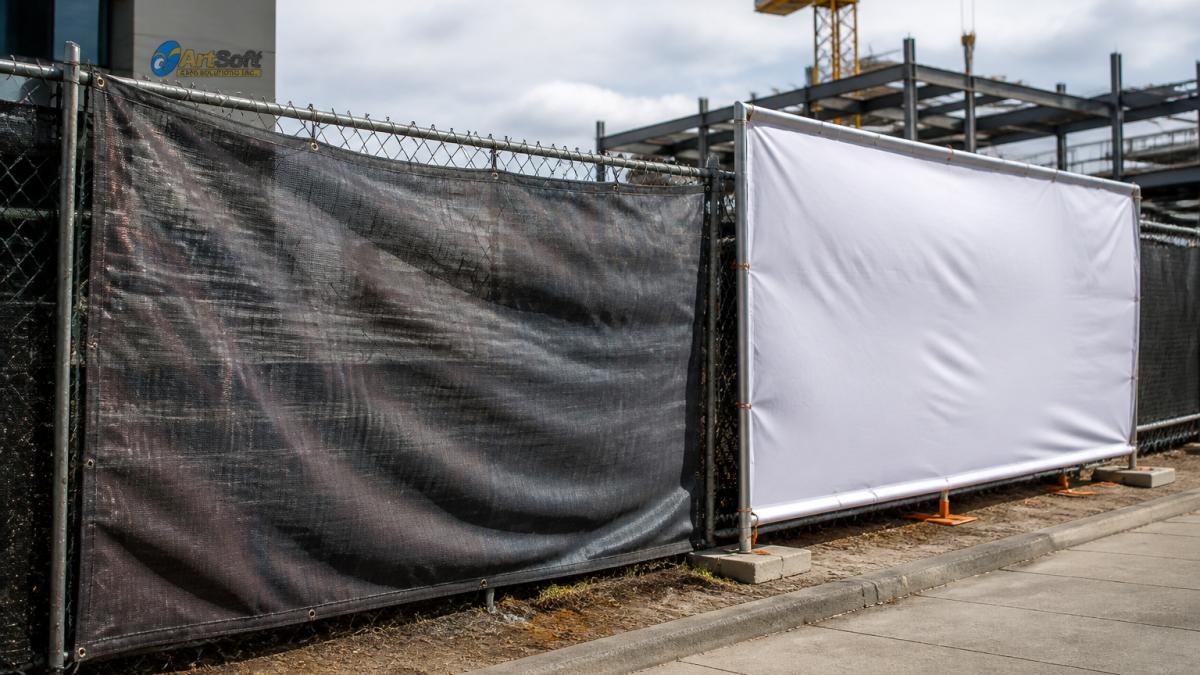
Mesh wins on wind resistance, and it is not close. A solid vinyl banner acts as a sail, transferring every square foot of caught air into the mounting points.
How wind load actually builds
Wind force rises with the square of wind speed and linearly with surface area: double the wind speed and load roughly quadruples; double the area and load roughly doubles.
A 0.9 m × 2.4 m banner presents 2.2 square metres of sail area, manageable on a solid wall in a moderate breeze, but on an open fence line in gustier conditions it can load its grommets and hems far beyond what a calm-day install suggests.
Practical wind-load guidance by size, mounting and exposure
The table below turns "mesh is wind-friendly" into a decision aid. It is guidance, not an engineering certification; for large or safety-critical installations, have the mounting structure and attachment points reviewed by a qualified person.
| Banner size | Mounting method | Sheltered exposure | Open exposure |
|---|---|---|---|
| Up to about 0.9 m × 1.8 m | Wall, window, frame | Vinyl acceptable with solid fixings | Mesh preferred; vinyl only with reinforced hems and close grommet spacing |
| About 0.9 m × 3 m to 1.2 m × 3.6 m | Fence, hoarding, frame | Vinyl acceptable if fully backed | Mesh with reinforced hems and grommets at closer spacing |
| Larger than about 1.2 m × 3.6 m | Fence line, building face, scaffold | Mesh strongly preferred | Mesh only, with wind holes or fully perforated face and engineered attachment |
Exposure is the other half of the calculation. A banner on a wall that blocks prevailing wind sees far less load than the same banner on a fence at the edge of an open lot, a rooftop or a shoreline.
Attachment spacing and finishing that survives wind
Grommets are where most wind failures start. On exposed sites, space grommets every 0.5 to 0.6 metres rather than every 0.6 to 0.9 metres, and use reinforced hems; stitched outlasts taped on anything that flexes.
Bungee cord or tensioned tie-downs distribute load better than rope pulled tight through a single grommet, allowing slight movement instead of concentrating force at one point.
For windy placements, an outdoor hanging banner built from mesh gives you a product designed for exactly this load case.
Weather, Sun and UV: Durability and Outdoor Lifespan
Weather resistance splits into water, sun and abrasion. Both materials handle rain and humidity well because both are vinyl-based and do not absorb water like fabric.
UV resistance is the long-term concern. Sunlight breaks down plasticizers in any vinyl substrate, showing first as fading and then brittleness.
Durability also depends on finishing. Stitched and reinforced hems outlast taped hems on any banner that will be pulled and flexed.
For readers weighing materials across a full outdoor signage program, our guide to durable materials for outdoor sports team signage goes deeper into weather resistance and material selection.
Print Quality, Color Vibrancy and Visibility Through Mesh
Print quality favors vinyl. A solid surface accepts ink without interruption, so fine text, thin logos and gradients come out clean and sharp, and color vibrancy is higher because no holes break up the ink layer.
Mesh is not far behind at a distance, and that distinction matters. Perforated material is designed to be read from across a parking lot, roadway or field, not from arm's length; at those distances the perforations vanish and the graphic reads as intended.
Distance-based visibility: what reads and what disappears
The practical question is not "which is sharper" but "what will my audience actually see from where they stand." The table below gives working guidance for typical outdoor viewing conditions, assuming good contrast and daylight; overcast light, glare and low sun all reduce legibility.
| Viewing distance | Minimum text height (rule of thumb) | Vinyl vs mesh |
|---|---|---|
| Up to about 3 m (close) | About 2.5 cm per 3 m of distance | Vinyl clearly better; mesh grid visible |
| About 3-9 m (sidewalk, storefront) | About 5-7.5 cm | Vinyl preferred for fine print; mesh acceptable for bold type |
| About 9-30 m (parking lot, roadway edge) | About 15-30 cm | Mesh performs well; perforations largely disappear |
| Beyond about 30 m (field, highway) | 30 cm and up | Mesh works well; bold logos and large type only |
A common signage rule of thumb is roughly 2.5 cm of letter height per 3 metres of viewing distance, with larger type for moving viewers or poor contrast. Use that as a starting point, then size up for mesh and for text that must be read quickly.
Contrast, color and the mesh grid
Mesh perforations reduce effective ink coverage, so low-contrast designs suffer more on mesh. Dark text on a light background, or light on dark, holds up best.
Color vibrancy is higher on vinyl because the ink layer is continuous. On mesh, colors read slightly less saturated up close but recover at distance as the perforations blend visually. For precise brand color matching, vinyl gives the tighter result.
Visibility through mesh
Because the material is perforated, a mesh banner on a fence or window lets light and silhouettes through from behind, useful on construction hoarding and crowd-control fencing. Vinyl blocks the view entirely. That see-through quality is a functional benefit, not just a print trade-off: it keeps a site looking open while still carrying the message.
How to judge the trade-off before you order
A transparent way to compare is to define what you are measuring: legibility at the intended viewing distance, color accuracy against brand standards, and detail retention for small elements. Most print providers will produce a small proof or sample on each substrate so you can check those three measures under real viewing conditions rather than guessing from a screen; ask before committing to a large mesh order where fine detail matters.
Here is the practical guidance we give:
- Close viewing, fine print, QR codes: vinyl.
- Distance viewing, large type, bold logos: mesh works well.
- Mixed audience: use mesh for the big outdoor piece and vinyl for any close-range signage nearby.
Custom Banner Printing Costs and Total Cost of Ownership
Custom banner printing costs are lower per square foot on vinyl at the entry level, but the cheaper sticker price is not the whole calculation.
Total cost of ownership changes the ranking.
Finishing adds to either material and should be budgeted from the start.
To price out a full order across substrates and sizes, you can browse our large format printing range.
Large Format Printing Best Practices for Outdoor Banners
Large format printing best practices for outdoor work start before the file reaches the printer.
- Match the material to the exposure. Solid vinyl for sheltered, mesh for exposed.
- Add wind holes or specify mesh for any large banner on an open site.
- Specify stitched or reinforced hems on anything that will flex.
On the file side, design for distance: large type, high contrast, and logos that survive being seen from across a lot.
Installation safety deserves a mention most guides skip.
For event-specific work, our large format printing guide for event activations extends these practices into temporary and modular setups.
Ordering Outdoor Banners From Artsoft Expo Solutions Inc.
Ordering the right outdoor banner comes down to matching material to site.
Our 13oz vinyl banner is the standard choice for storefronts, interiors and sheltered event signage, with matte or gloss finishing, grommets, pole pockets, wind holes and Velcro available.

Both products ship fast, and our lightweight hardware keeps setup simple whether you are outfitting a single storefront or a full tradeshow schedule.
Outdoor signage fails for predictable reasons: the wrong substrate for the wind, weak finishing, or mounting never rated for the load.
Frequently Asked Questions
Are mesh banners better than vinyl for high-wind outdoor environments?
For exposed sites, yes. The perforated surface on mesh banners lets air pass through instead of catching it, so gusts put far less strain on grommets, hems and the fence or frame behind the banner. Vinyl is solid, so it works like a sail and takes the full wind load. On a fence line, a building face or an open field, mesh banners are the safer pick. Vinyl still suits sheltered spots or short events in calm weather, especially when you need maximum print sharpness.
How does print quality compare between vinyl and mesh banners?
Vinyl gives the crisper result. Its solid surface holds fine text, small logos and dense gradients without interruption, which matters for close viewing at retail or indoor events. Mesh banners print at high resolution too, but the perforations break up the image slightly, so fine detail softens at close range. From 3 metres or more, most viewers cannot tell the difference, and the mesh pattern becomes almost invisible. Use vinyl for detail, mesh for distance.
What is the expected lifespan of outdoor vinyl banners in extreme weather?
A standard 13oz vinyl banner typically holds up for one to two years outdoors when it is properly hemmed, grommeted and mounted with some slack. Heavy-duty 18oz material lasts longer, often three years or more in sheltered positions. Heat, UV, freezing rain and constant flapping all shorten that window. Mesh banners usually run longer on exposed fences because wind stress is lower, though the print itself fades at a similar rate on both materials.
Which banner material is more cost-effective for large-scale displays?
Compare the price per square foot against how often you will replace it. Artsoft's 13oz vinyl banner starts at $3.00 and the 18oz heavy-duty material at $12.00, while the 8oz mesh banner starts at $6.00. On a windy site, a cheaper vinyl banner that shreds in one season costs more than mesh that survives three. On a sheltered wall where vinyl lasts, vinyl wins on price. Finishing such as stitched hems adds a small per-linear-foot charge on mesh.
Can mesh banners be used for high-resolution graphics?
They can, with one caveat. Mesh banners accept detailed artwork, and logos, bold headlines and photos all read well from a normal viewing distance. The perforated material simply reduces the sharpness of very fine lines and small type when someone stands close. For sponsorship banners on a sports fence or building wraps seen from the street, that trade-off is invisible. If the design depends on tiny text or intricate detail, print it on vinyl instead.
